Social Wall
  Feed Analytics


Lots of people who have websites want to show different ideas or voices. In my experience working on websites and online marketing, I’ve found that bringing different views together makes a site feel more alive and current.
X (Twitter) is a platform that thrives on diverse conversations.
If your website could benefit from showing multiple X (Twitter) feeds, perhaps from different team members, event speakers, or related organizations, then aggregating those feeds is a great solution.
Quick Answer: The easiest way to aggregate X (Twitter) feeds on your site is with a WordPress plugin like Smash Balloon X (Twitter) Feed Pro, which lets you combine X posts from multiple accounts, hashtags, and lists into a single feed using a guided 3-step setup.
By displaying an aggregated X (Twitter) feed, you present a unified stream of X posts from multiple sources directly on your site. This offers your visitors a richer, more comprehensive view of relevant X (Twitter) discussions.
In this article, I’ll walk you through a step-by-step process to combine X (Twitter) content from various accounts into a single, dynamic display.
In This Article
- What is an X (Twitter) Aggregator?
- Easiest Way to Aggregate X (Twitter) Feeds to WordPress
- How to Aggregate X (Twitter) Feeds on Your Website Easily
What is an X (Twitter) Aggregator?
An X (Twitter) aggregator is a tool that you can use to display X (Twitter) posts on your website.
Using a social media feed aggregator specifically for X (Twitter), you can organize X (Twitter) content into feeds and embed these feeds on your pages, sidebar, or footer.
A feed pulling from multiple sources gives visitors more reasons to keep scrolling than a single account ever could, which means more time on page and more fresh, keyword-rich content for search engines to crawl.
And that’s just the start! Here are a few more ways X (Twitter) aggregators can help your business:
- Combine your brand account with a branded hashtag, and visitors see a fuller picture of who’s talking about you, not just your own posts.
- By displaying reviews and testimonials for your products, you can turn X (Twitter) into a full UGC gallery and convince more people to make a purchase.
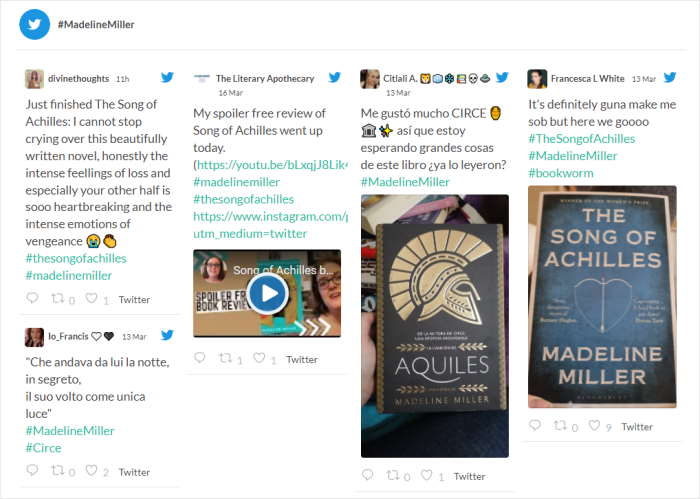
- Using an X (Twitter) image aggregator, you can also show beautiful visual content that immediately grabs people’s attention.
- A single-account feed only proves you’re active. An aggregated feed, your account plus your community’s mentions, proves people are actually engaging with you.
As you can see, X (Twitter) aggregators can be a great help for your website. You can get more sales, grow your social media presence, reach more customers, and much more.
If you eventually want to combine X (Twitter) with feeds from Instagram, Facebook, or YouTube too, Social Wall does that in one unified display, but for now, let’s focus on getting your X (Twitter) feed aggregated.
Ready to show X (Twitter) feeds using a social media aggregator?
Let’s take a look at the easiest way to aggregate X (Twitter) feeds on your WordPress website.
Easiest Way to Aggregate X (Twitter) Feeds to WordPress
I’ve tried most of the X (Twitter) aggregators on the market. Most of them make you trade something away: you lose branding control, you’re stuck with a single account, or the free tier looks fine until you actually need more than one feed.
Smash Balloon X (Twitter) Feed Pro is the one I keep coming back to because it doesn’t force that trade-off.
How X (Twitter) Feed Pro Compares
| Native X (Twitter) Embed Widget | Free Aggregators (Curator, Juicer, etc.) | X (Twitter) Feed Pro ⭐ Recommended | |
|---|---|---|---|
| Can you combine multiple accounts, hashtags, or lists in one feed? | ❌ No — one source only | ⚠️ Usually 1-3 sources on free plans | ✅ Yes — unlimited sources, mix and match feed types |
| Does it match your site’s design? | ❌ No — fixed X (Twitter) styling | ⚠️ Limited color/layout control on free tiers | ✅ Yes — 7 templates, live customizer, inherits your theme |
| Any branding or ads on your feed? | ✅ None | ❌ Most free plans show the tool’s own branding or ads | ✅ None |
| Best for | A single embedded post, nothing more | Testing the concept for free before committing | A fully branded, reliable aggregated feed |
If you just need to drop in one X post, X (Twitter)’s own widget works fine. If you want an aggregated feed that actually looks like part of your site, X (Twitter) Feed Pro is the faster path.
In fact, the plugin walks you through the setup in 3 steps. I didn’t have to open a code editor once or manage any embed codes.

To make your X (Twitter) feeds even more engaging, you can choose from a collection of beautiful pre-built templates. Just pick a template you prefer, and your X (Twitter) feed will instantly copy that design.
What’s more, you get a live feed editor where you can customize how your X (Twitter) feed looks with a real-time preview.
That way, you can quickly and easily change your layout, color scheme, number of X posts, feed size, header style, and much more.

Plus, you can use X (Twitter) Feed Pro to aggregate X (Twitter) content in lots of different ways, including X (Twitter) hashtag feeds, X (Twitter) lists, advanced search results, and more.
In fact, X (Twitter) Feed Pro currently has a 4.9/5 rating from 150,000+ users, which tells me I’m not the only one who’s found it reliable.

Ready to aggregate X (Twitter) feeds and grow your business? Get your copy of X (Twitter) Feed Pro here.
Now, let’s get started with our tutorial and show you how you can aggregate X (Twitter) feeds in the easiest way possible.
How to Aggregate X (Twitter) Feeds on Your Website Easily
Here’s the short version: Install X (Twitter) Feed Pro, create a new feed and choose your content type, connect your account, customize the design with the live editor, then embed it on a page, sidebar, or footer.
The whole process takes most people under 10 minutes. Let’s get started!
Step 1: Install Smash Balloon X (Twitter) Feed Pro
Grab the X (Twitter) Feed Pro plugin here and install it like any other WordPress plugin.
If you’ve never installed one before, the WPBeginner guide covers it in under two minutes.
After you install and activate the plugin, you can start aggregating X (Twitter) content in step 2.
Step 2: Create an Aggregate X (Twitter) Feed
Now, you can use X (Twitter) Feed Pro to create a new feed on your site.
To do that, navigate to the X (Twitter) Feed » All Feeds menu from your WordPress dashboard. On the new page, click on the Add New button at the top.
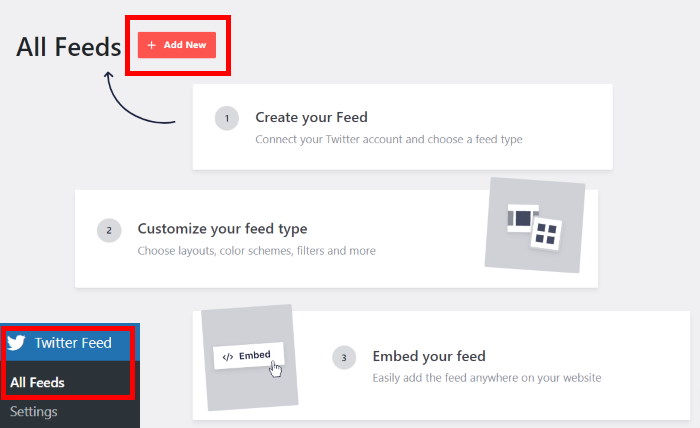
This will create a new X (Twitter) feed for your website. Next, you can choose what type of X (Twitter) content you want to aggregate using this feed.
You can pick from 4 different feed types, and each will aggregate different types of X (Twitter) content:
- User Timeline: Show X posts from X (Twitter) user profiles
- Hashtag: Embed X posts that have specific hashtags
- Search: Show the results of an X (Twitter) search
- Lists: Display X posts posted by the accounts in a specific X (Twitter) list
This is where the aggregation actually happens. Plus, if you select more than one option, X (Twitter) Feed Pro pulls from all of them into a single feed.
Select one or more feed types and click on Next.
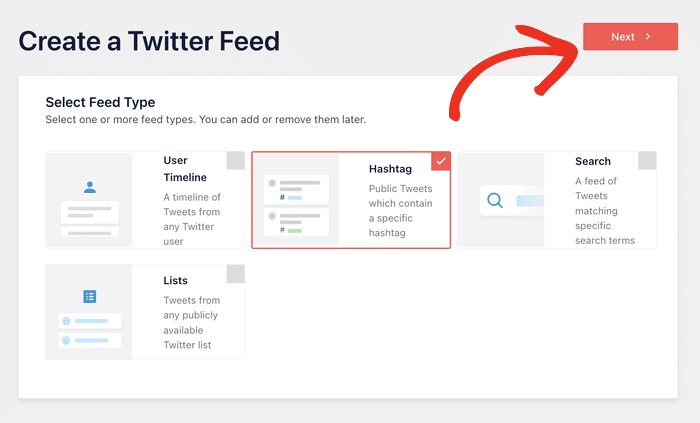
In this tutorial, I’m going to go ahead and choose an X (Twitter) hashtag feed as a demonstration.
Just like that, you now have a new X (Twitter) feed on your website. In the next step, you can connect it to your X (Twitter) account.
Step 3: Connect Your X (Twitter) Account
Using X (Twitter) Feed Pro, you can connect your new feed to X (Twitter) with a few simple clicks.
Ready to get started? On the popup, click on the Connect button.
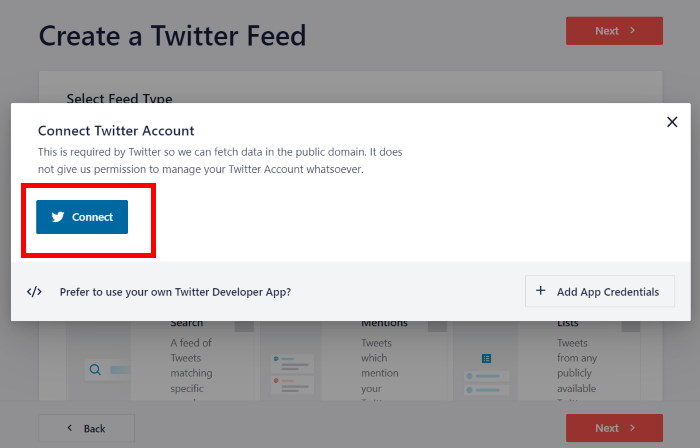
You’ll see a permissions screen asking for read-only access, meaning the plugin can pull your X posts but can’t post, follow, or change anything on your behalf.
Click Authorize app and you’re connected.
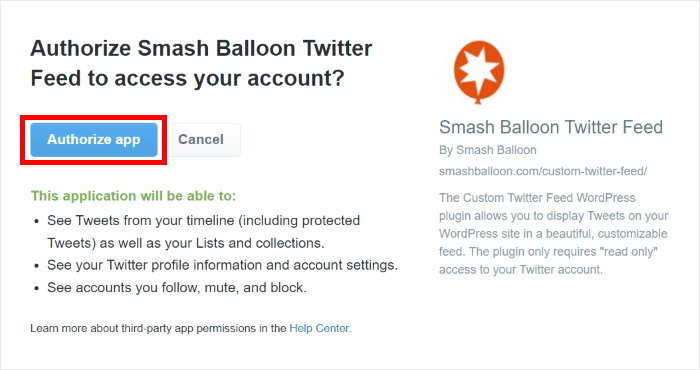
Doing that will bring you back to your WordPress website once again. From here, you can now choose the source for your X (Twitter) feed.
That means you can enter X (Twitter) handles, hashtags, search terms, X (Twitter) lists, and more on the popup. Then, your feed will start showing the X posts from that source.
Since we picked the hashtag feed type earlier, we’ll enter a hashtag for our example.
After that, click on the Next button to continue.
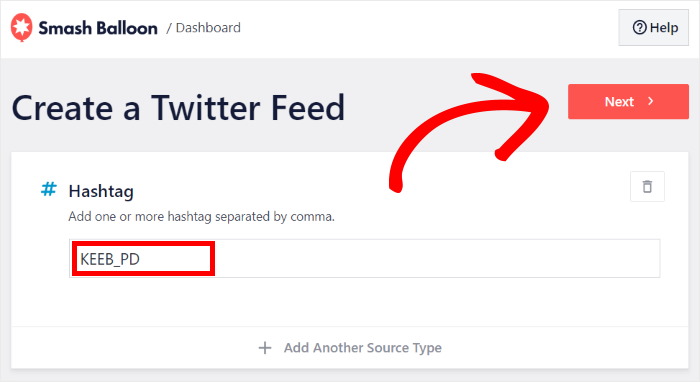
Now that you’ve connected your X (Twitter) account and chosen the source, your feed is ready to aggregate X (Twitter) content.
Before adding the feed to your website, you can customize how it looks in step 4.
Step 4: Customize Your X (Twitter) Feed
With X (Twitter) Feed Pro, your feeds will automatically copy the design of your website and look amazing right out of the box.
And if you want more control over your X (Twitter) feed, there are tons of customization options that you can use.
First, you can choose a template that you want to use for your X (Twitter) feed. You get to pick from 7 different feed templates here:
- Default
- Masonry
- Simple Carousel
- Simple Cards
- Showcase Carousel
- Latest X posts
- Widget
Select the feed template that you prefer and then click on the Next button.
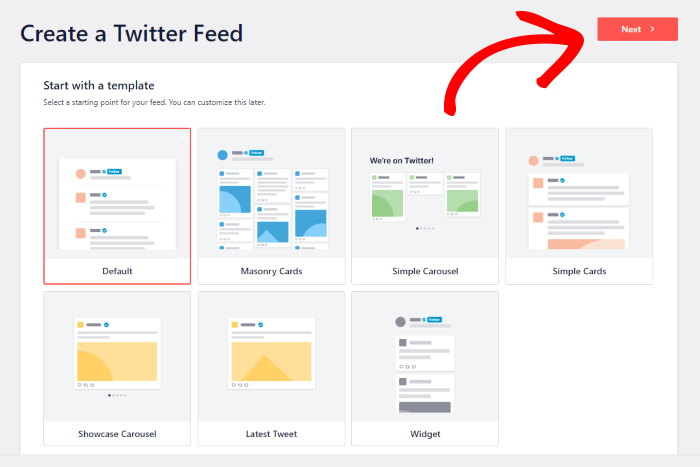
After you pick a template, you can use the live feed editor to customize your X (Twitter) feed even more.
Towards the left, you can find the customization panel. Using the options there, you can set your feed layout, color scheme, header style, button design, and much more.
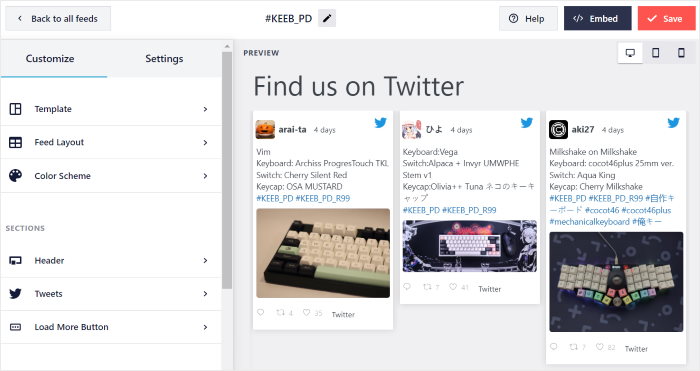
When you use these options, you can see a live preview of your changes on the right. That way, you’ll have a real-time view of how your X (Twitter) feed looks.
To get started, look for the Feed Layout option on the left and click on it.
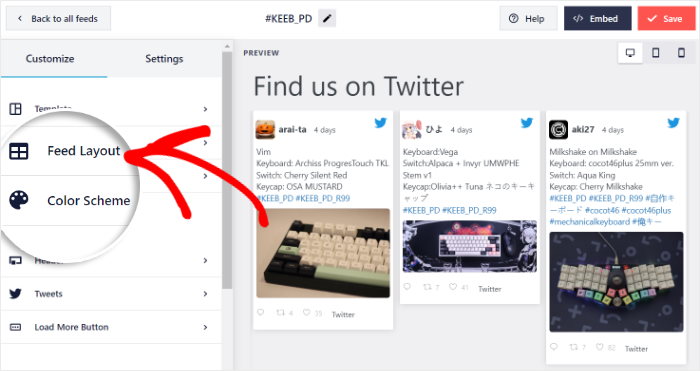
From here, you can choose between 3 layouts for your X (Twitter) feed: List, Masonry, and Carousel.
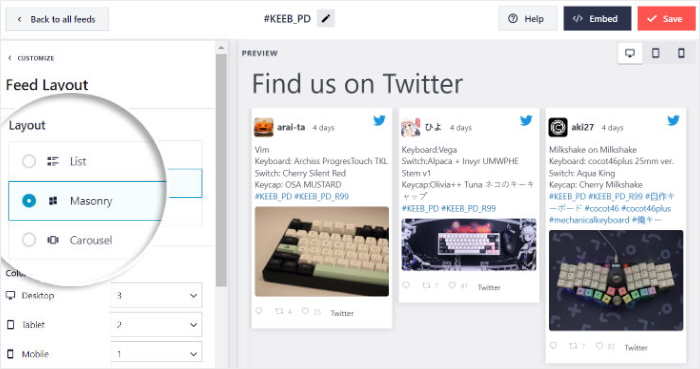
Want each X post to get more space on your page?
You can pick the list layout, which shows all the X posts in a single column.

If you want to aggregate a lot of X (Twitter) content at once, the masonry layout can help you out.
This option will show your X posts in lots of different columns at once.

Lastly, we have the carousel layout, which shows X posts using a beautiful X (Twitter) slideshow carousel.
As a result, you can show a lot of X posts without taking much space on your page.

Once you pick the X (Twitter) feed layout that you want to use, click on Save.
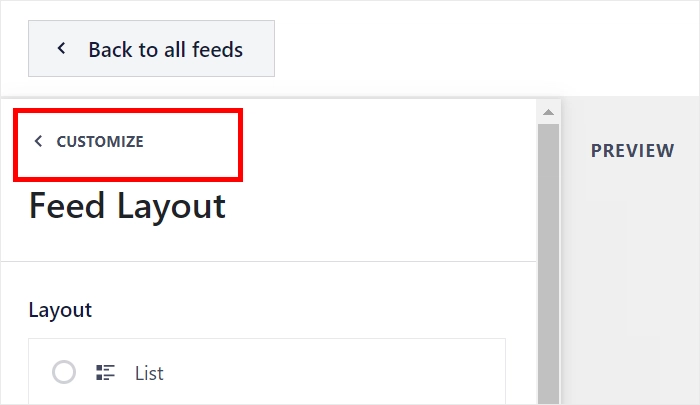
To continue editing the design of your X (Twitter) feed, click on the small Customize button at the top.
Next, you can click on the Color Scheme option on the left to start setting the colors of your X (Twitter) feed.
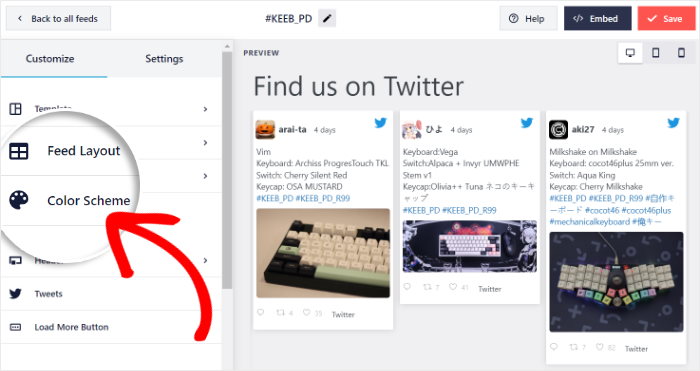
With this plugin, you can simply choose a color scheme to instantly change all the colors of your X (Twitter) feed at once:
- Inherit from Theme: Use the same colors as your website’s theme
- Light: Show a light background and a dark font for your feed
- Dark: Pick a darker background along with a light font
- Custom: Manually select your colors yourself
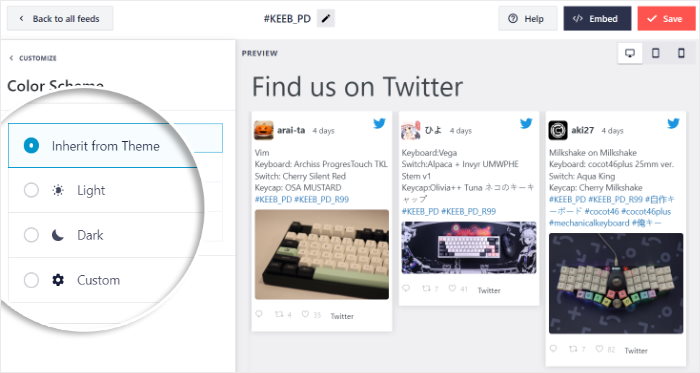
Select a color scheme that you prefer and then click on Save once again.
On the whole, the live feed editor covers the details most people actually care about: font, header style, text length, and your ‘load more’ button, all with a preview that updates as you go.
Finally, click on the Save button to confirm your changes.
When you’re done styling your X (Twitter) feed, it’s time to embed it on your WordPress website below.
Step 5: Embed Your X (Twitter) Feed on Your WordPress Site
To show the collected X (Twitter) content on your site, you have 2 methods to pick from:
- Aggregate X (Twitter) feed on a WordPress page
- Aggregate X (Twitter) feed on your WordPress sidebar or footer
Let’s take a look at how you can use both of these methods below.
Aggregate X (Twitter) Feed on a WordPress Page
With this method, you can show X (Twitter) content on your pages so it acts like the main focus and engages visitors. Plus, you can start doing that directly from the live feed editor.
Just click on the Embed button at the top to get started.
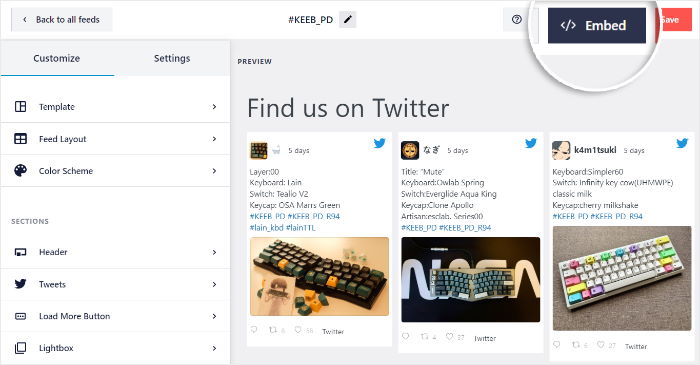
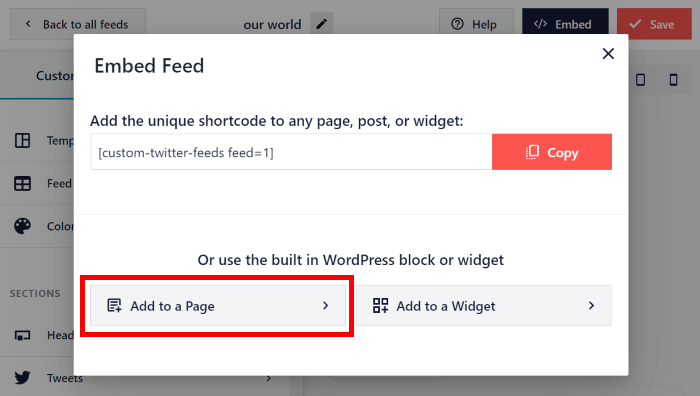
Once you do that, X (Twitter) Feed Pro will show you a popup that asks where you want to embed the X (Twitter) feed.
To continue, click on Add to a Page.
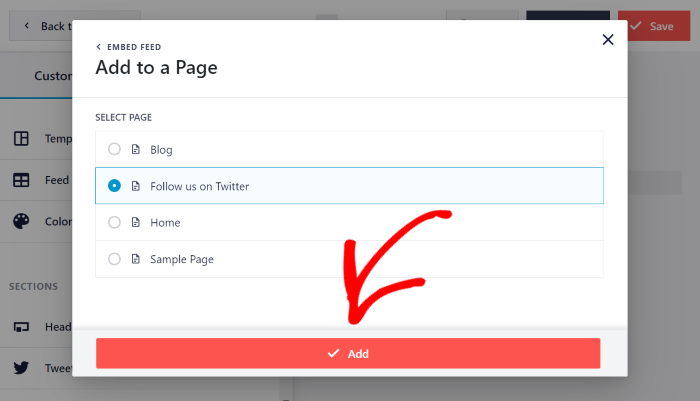
After that, you can see a list of pages that you have on your website.
From the list, select the page where you want to aggregate your X (Twitter) content and then click on the Add button below.
Now, the plugin will send you to that page so you can embed your X (Twitter) feed using the WordPress editor.
First, add a content block to the editor by clicking on the plus (+) icon.

Using the search bar, look for the “twitter feed” block. Then, click on X (Twitter) Feed in the search results below.
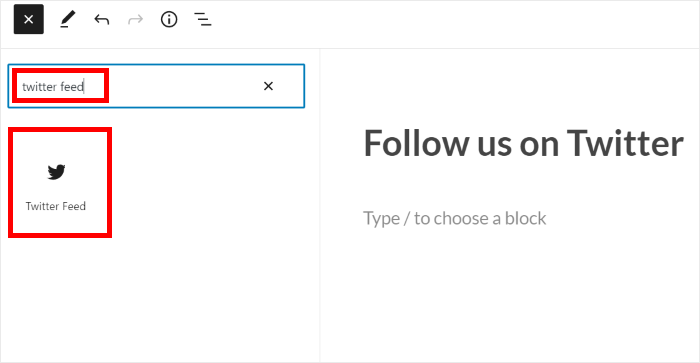
Finally, click on Publish or Update to confirm your changes, and your X (Twitter) feed will be online.
Now, the feed will aggregate content from X (Twitter) and show it to your visitors. You can just open your WordPress page to take a look.
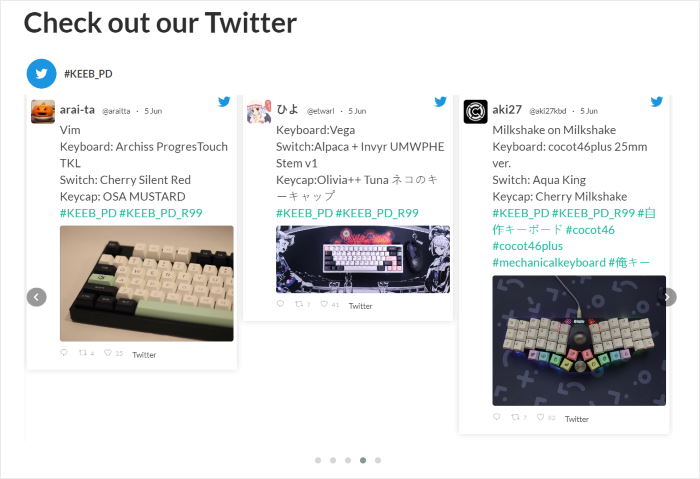
Aggregate X (Twitter) Feed on Your WordPress Sidebar or Footer
Another way to show X posts on your website is by displaying an X (Twitter) feed widget.
First, go to the X (Twitter) Feed » All Feeds menu from your dashboard. You can then see all the X (Twitter) feeds you created on this page.
Now click on the X (Twitter) feed you just created to open it in the live feed editor.
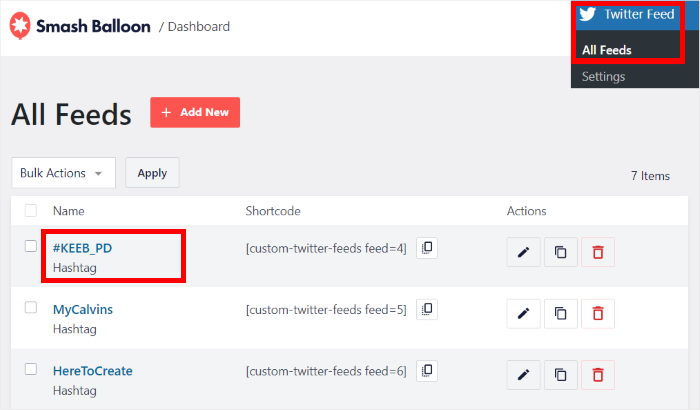
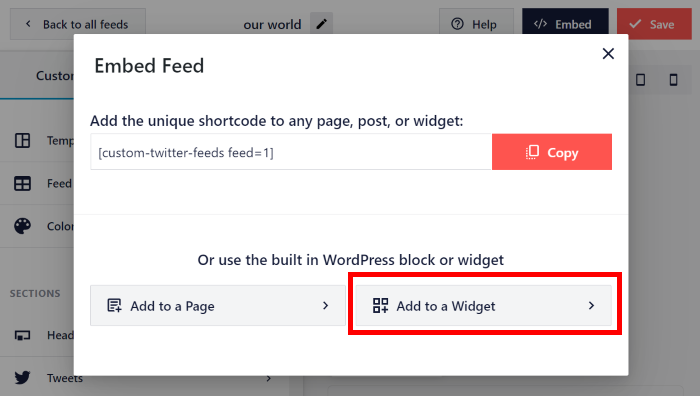
From the live feed editor, click on the Embed button in the top right corner to get started.
On the popup, click on the Add to a Widget option to continue.
After you do that, X (Twitter) Feed Pro will send you to the WordPress widgets page.
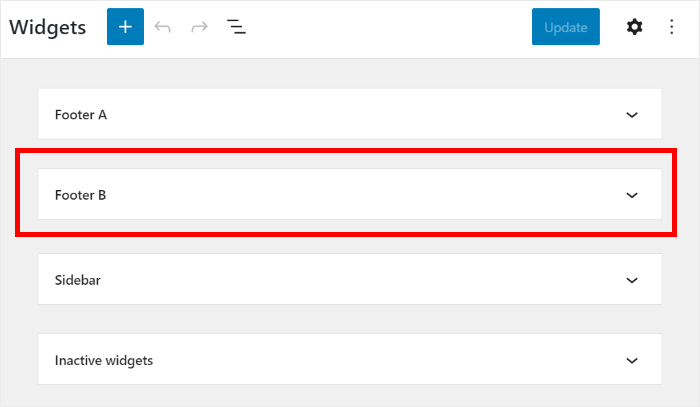
Here, you can choose where you want to embed the X (Twitter) widget.
To show X (Twitter) content on your sidebar, select the Sidebar panel.
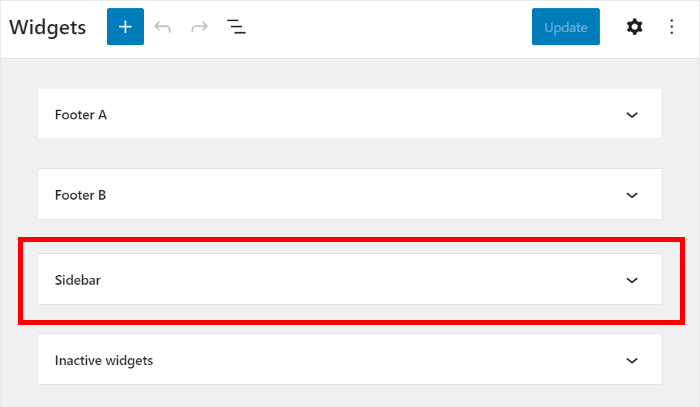
If you prefer to show X posts on your footer instead, click on Footer.
For our example, we’ll use the sidebar of the website.
Now, add a new X (Twitter) widget by clicking on the plus icon (+) at the bottom.
Finally, select the X (Twitter) Feed widget from the options.
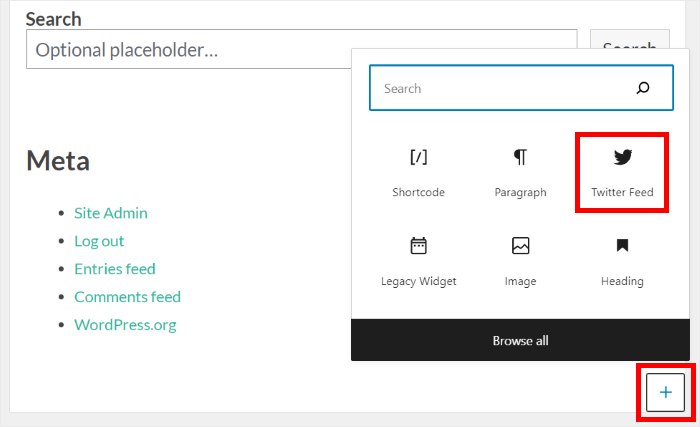
If you click on the Update button at the top, your new X (Twitter) widget will be online.
Now, open your website, and you can check out the aggregated X (Twitter) content on your footer or sidebar.
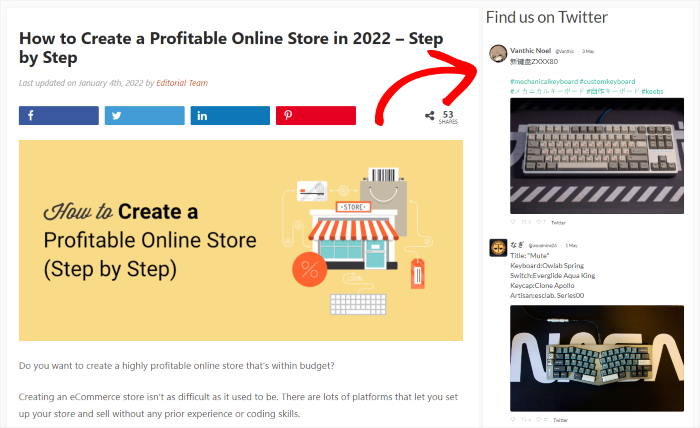
That’s the whole setup, from install to a live aggregated feed. The real value shows up over time: instead of manually pasting in new X posts, your feed refreshes on its own every time that hashtag picks up new activity.
Add a second or third source later, and it keeps working exactly the same way, no extra setup required.
From here, the feed keeps itself current without you touching it again, which is really the point of aggregating in the first place instead of manually embedding one static X post.
Ready to aggregate X (Twitter) feeds? Get your copy of X (Twitter) Feed Pro here.
While you’re here, you can take a look at our list of the top ways to make money on X (Twitter).
You may also want to read our next post on the best X (Twitter) widget examples you can add to your site.