Social Wall
  Feed Analytics

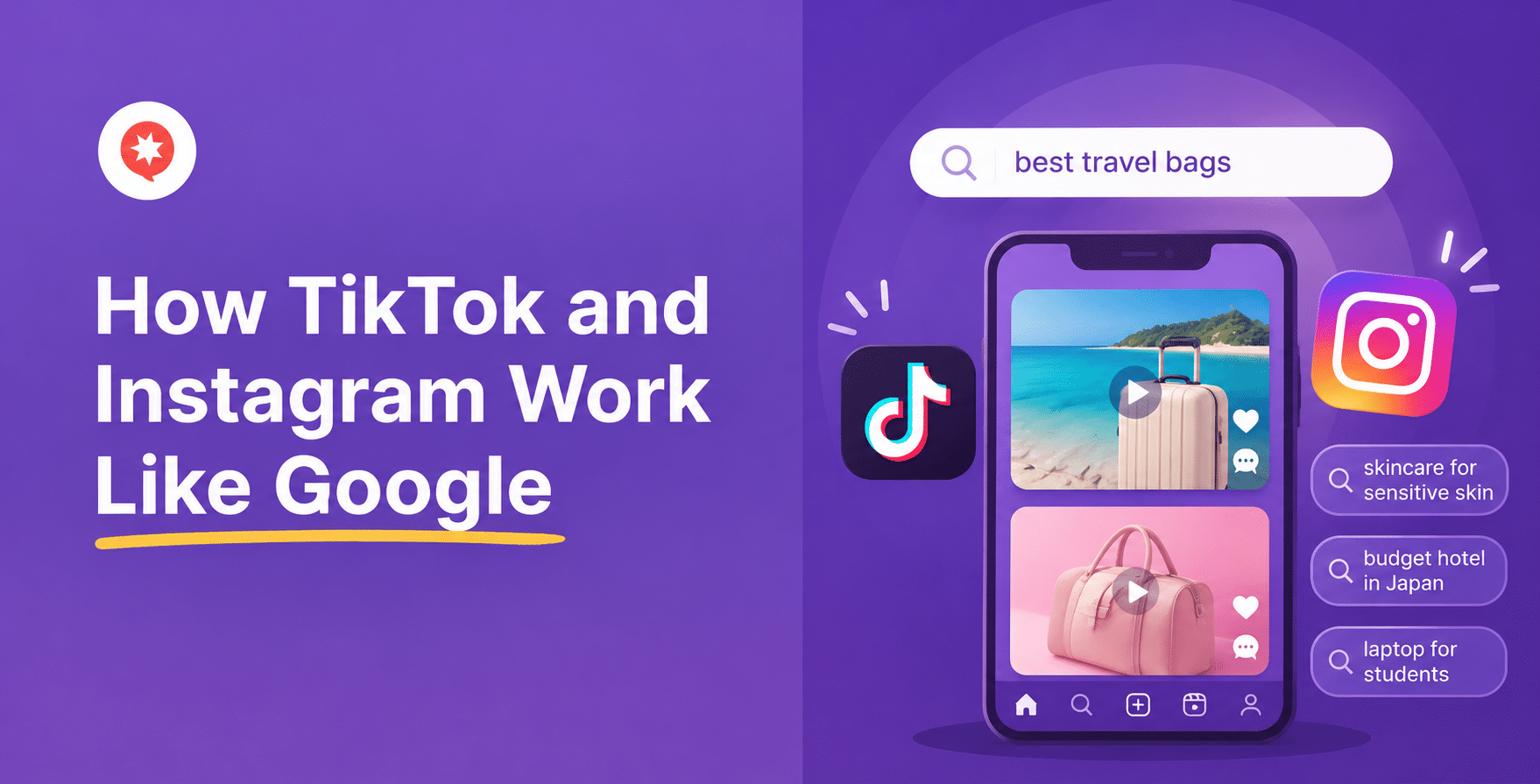
If you search “best tacos near me” on Google, you get ads, a map, and a handful of listicles. Search the same thing on TikTok, and you get someone standing in front of the taco stand, eating one, telling you if it’s worth the wait.
For a specific kind of question, that video answer is starting to compete with Google.
I manage content across Instagram, TikTok, and search for Smash Balloon, and I’ve watched this shift happen firsthand over the past year.
It’s real, but it’s smaller and more specific than most of the coverage on this topic makes it sound, and a lot of that coverage is recycling the same handful of stats without checking whether they still agree with each other.
Here’s the quick version: people aren’t abandoning Google. They’re routing certain kinds of questions, mostly visual, local, and recommendation-based ones, to TikTok and Instagram instead. That shift is what’s now being called social media search, and if your content strategy only accounts for Google, you’re missing where a real chunk of your audience is already looking.
In This Article
- Are People Really Searching on TikTok and Instagram?
- How We Got Here
- What Social Search Actually Looks Like
- Why This Is Happening: Two Different Ranking Systems
- The Perception Gap Nobody's Talking About
- Platform by Platform: How Search Actually Works on Each
- The Bigger Shift Underneath This One
- How to Optimize Your Content for Social Media Search
- What Social Search Means for Your Website
- FAQs on Social Search in 2026
- Start Treating Your Social Content Like Search Content
Are People Really Searching on TikTok and Instagram?
Yes, but how you measure it changes the story completely depending on which study you read.
Here’s every major data point on this, side by side, so you can see why the “TikTok is replacing Google” headlines and the “Gen Z still trusts Google most” headlines are both technically true.
| Source | Year | Who Was Asked | The Question | The Result |
|---|---|---|---|---|
| Google SVP Prabhakar Raghavan (via TechCrunch) | 2022 | Internal Google research, methodology not published | Where do you look for a lunch recommendation | Nearly 40% of 18-24 year-olds go to TikTok or Instagram instead of Google Maps or Search |
| SOCI (via Forbes) | 2024 | 1,002 US consumers, ages 18-24 | Which platform is most helpful for search | Instagram 67%, TikTok 62%, Google 61% |
| HerCampus (via eMarketer) | 2023-2024 | Gen Z respondents, sample size not disclosed | Do you use TikTok for search, do you prefer it over Google | 74% have used TikTok for search, 51% prefer it over Google |
| Adobe Express / SurveyMonkey | 2026 | 807 consumers plus 200 business owners, roughly 120 Gen Z respondents | Have you used TikTok as a search engine, which platform is most helpful | 65% of Gen Z have tried TikTok search, but only 4% call it more helpful than Google, down from 8% in 2024 |
Four studies, four different questions, four different-sounding conclusions, and none of them is actually wrong.
They’re measuring different things: whether people have tried social search, whether they prefer it for one specific kind of question, and whether they trust it more than Google overall.
Adobe’s is the most recent and the most direct on that last point, and it says usage is up while actual preference over Google is down. It’s also worth noting that Adobe’s Gen Z subsample is small, around 120 respondents, so treat the exact percentage as directional rather than precise.
How We Got Here
- 2022: A Google executive says nearly 40% of young people skip Google for lunch recommendations in favor of TikTok and Instagram. The “Gen Z is replacing Google” narrative begins.
- 2023-2024: Surveys from SOCI and HerCampus back it up. Instagram and TikTok edge out or match Google for search-style questions among 18-24 year-olds.
- 2026: Adobe’s follow-up finds usage climbed, 65% of Gen Z have tried TikTok search, but actual preference over Google fell by half, from 8% to 4%.
The honest read: people tried social search, used it more than before, and mostly decided Google still works better for finding answers they trust.
What Social Search Actually Looks Like
Social search shows up for a narrow set of query types, and they all share something in common: a video or photo answers the question faster than text does.
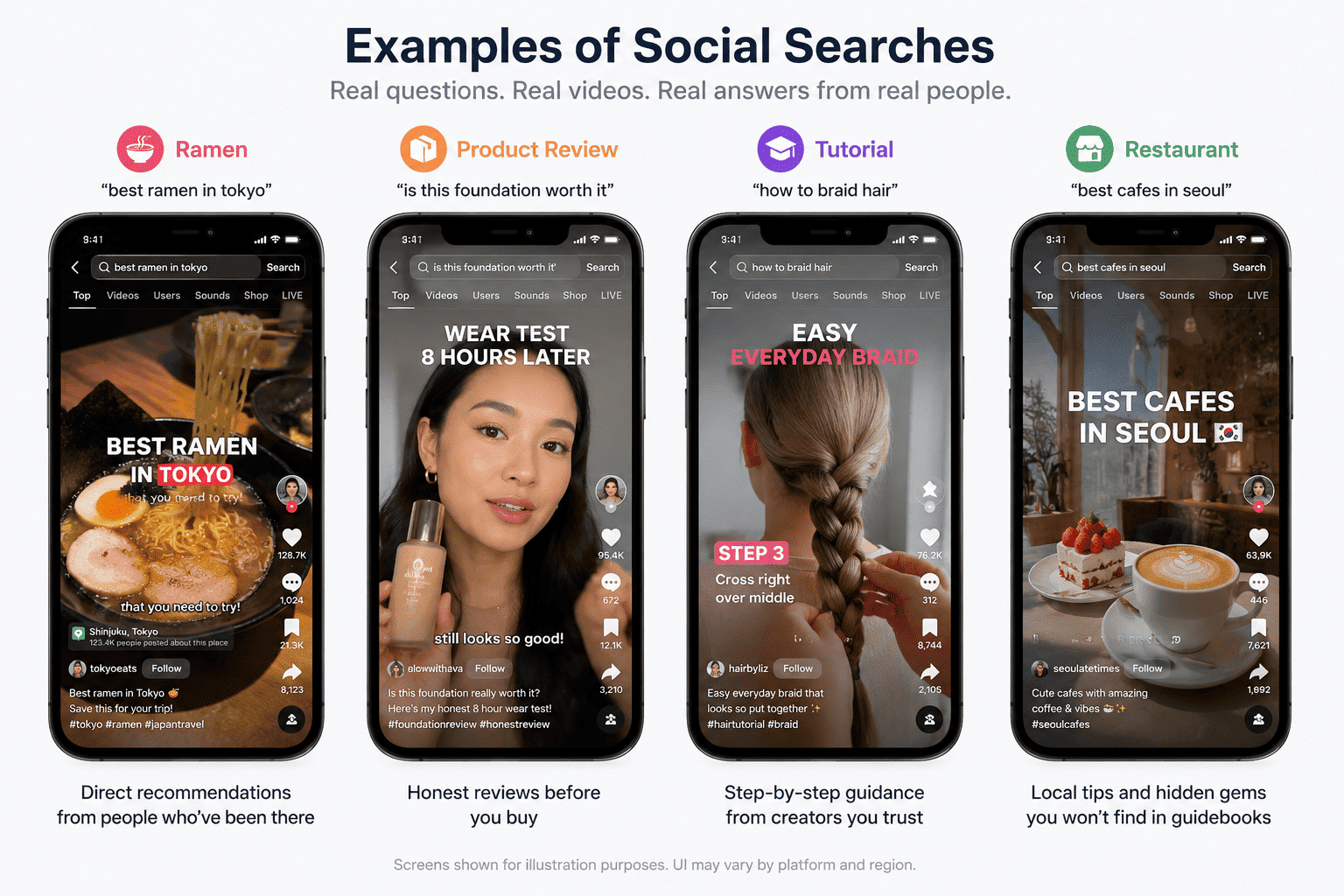
| What People Search | Example | Why Video Wins |
|---|---|---|
| Local recommendation | “Best ramen in Austin” | Shows real portions, real prices, real reactions instead of a star rating |
| Visual how-to | “How to fold a fitted sheet” | A demonstration beats a paragraph of instructions every time |
| Product validation | “Is the [product] worth it” | You see the product in someone’s actual hands, not a stock photo |
| Brand reputation | “[Brand name] review” | A stranger with nothing to gain reads as more honest than a website talking about itself |
For visual, local, or show-me-don’t-tell-me questions, video wins. That’s not a trend line, that’s just how those questions get answered better.
Why This Is Happening: Two Different Ranking Systems
Most explanations for this shift stop at “TikTok feels more authentic.” That’s true, but it skips the more useful part:
TikTok and Google aren’t ranking content the same way, and understanding the difference changes how you’d actually create for each one.
Google ranks primarily on backlinks, site authority, and E-E-A-T signals, experience, expertise, authoritativeness, and trust built up over time.
TikTok ranks on completion rate, rewatches, and how closely your spoken words and captions match what someone typed into the search bar. There’s no backlink equivalent and no domain authority.
A brand-new account can outrank an established one on a single video if people watch it all the way through and it matches the query closely enough.
That’s also why content doesn’t transfer directly between platforms. An article optimized to rank on Google won’t automatically work as a TikTok search result, and a video that ranks well on TikTok won’t help your Google ranking unless the same information also lives somewhere Google can crawl and read as text.
Put your optimized captions to work on your own site
Smash Balloon TikTok Feeds Pro pulls your videos directly onto your website and renders your captions as real, crawlable text next to them. The same content you just optimized for search and AI citation keeps working on a page you actually control.
Get My TikTok Feed LiveThe Perception Gap Nobody’s Talking About
When Adobe asked people which platform actually helped them find what they needed, Google scored 85% helpful.
Reddit came in at 29%, ChatGPT at 26%, YouTube at 24%, and TikTok dead last at 16%. A separate study from Website Builder Expert found an even starker version of the same gap: 91% found Google helpful for research, compared to 17% for TikTok.
Two studies, different samples, same conclusion: people are using TikTok and Instagram for search far more than they used to, but they don’t actually trust the results more. Usage went up. Confidence didn’t follow it.
Part of that gap comes down to a real structural difference.
Google has spent two decades building E-E-A-T signals and authority scoring specifically to separate reliable information from bad information.
TikTok’s ranking system optimizes for watch time and engagement, not accuracy. There’s no fact-checking layer built into TikTok search the way there is with Google’s core ranking systems, which is worth knowing if you’re using it to research something that actually matters, like a medical question or a financial decision.
Platform by Platform: How Search Actually Works on Each
TikTok alone has seven distinct ways people search inside the app: the search bar, the Discover page, hashtags, keyword or caption matching, sound search, direct user lookup, and Creator Search Insights for finding content gaps. Most coverage treats “TikTok search” as one feature. It’s closer to seven.
| Platform | How Search Works | Key Tactic |
|---|---|---|
| TikTok | Transcribes spoken audio and reads on-screen text, indexing both as searchable content. Hashtags function as keywords, not just categories. | Say your keyword out loud in the first 3 seconds of the video |
| Matches captions, bios, alt text, and location tags. Alt text now doubles as a discovery signal for Google’s own image search. | Write real, keyword-rich alt text on every post | |
| YouTube | Still the second largest search engine by most measures. Favors longer, more deliberate answers over quick recommendations. | Use tutorial and comparison formats, not just quick clips |
| Intent-driven discovery platform. 80% of users say they’ve discovered a new product or brand there, and 96% of top 2025 searches were unbranded. | Optimize for what people are looking for, not your brand name |
The Bigger Shift Underneath This One
While TikTok and Instagram search gets the headlines, the more consequential change might be happening one level up.
AI tools like ChatGPT, Perplexity, and Google’s own AI Overviews are increasingly pulling from social content when they answer questions, not just from traditional web pages.
That means a TikTok caption or an Instagram alt text description isn’t just competing to rank inside TikTok or Instagram anymore. It’s also a candidate to get cited, or ignored, by an AI system summarizing an answer for someone who never opens either app. The platforms driving social search and the platforms reshaping traditional search are starting to pull from the same pool of content.
Practically, that raises the stakes on getting the basics right: clear captions, accurate on-screen text, alt text that actually describes what’s happening. Not because it’s good practice in the abstract, but because it determines whether your content is even eligible to be cited anywhere outside the app it was posted in.
How to Optimize Your Content for Social Media Search
Getting found now happens on three levels, and most advice out there only covers the first one.
Layer 1: Inside the app. Say your keyword out loud in the first 3 seconds of a TikTok video, since it transcribes and indexes speech. Use 3 to 5 specific hashtags. Write real alt text and location tags on Instagram instead of leaving them blank.
Layer 2: Cross-platform consistency. Someone might search a topic on TikTok, then check Instagram, then Google the same question to compare. Keep your answer consistent across all three instead of treating each platform as a separate audience with a separate message.
Layer 3: AI and LLM citation. This is the layer almost no one optimizes for yet. Clear, specific, accurate captions and on-screen text are what let an AI system quote or summarize your content correctly. Vague captions get skipped. Specific ones, with real numbers and plain language, get cited.
Most businesses stop at layer 1. The ones showing up everywhere are working all three.
What Social Search Means for Your Website
Here’s the part most coverage of this topic skips entirely. The discovery increasingly happens on TikTok, Instagram, or inside an AI-generated answer. But the decision, and the trust-building, still tends to finish somewhere else: your actual website.
If someone finds you through a video and your website doesn’t reflect what they just watched, you lose the thread right when it mattered most. And if your site never surfaces that content as actual text, it’s invisible to Google and to whatever AI Overview or chatbot might otherwise cite it.
Smash Balloon helps website owners turn real social content into trust signals that increase credibility and conversions.
Smash Balloon TikTok Feeds Pro pulls your TikTok videos directly onto your site and renders the captions as real, Google-crawlable text, not just an embedded video.
Smash Balloon Instagram Feed Pro does the same for Instagram. The same content someone found through social search, or that an AI tool might cite, ends up living on a page you actually control.
FAQs on Social Search in 2026
Is TikTok replacing Google for search?
No, not broadly. TikTok is being used for a narrow set of visual, local, and recommendation-based questions, not general search. Adobe’s 2026 data found only 4% of Gen Z actually prefer TikTok over Google when they need an answer, down from 8% in 2024. It’s a supplement to Google for certain questions, not a replacement for it.
How do I get my business found on TikTok search?
Say your keyword out loud in the first few seconds of your video, since TikTok transcribes and indexes spoken audio. Use 3 to 5 specific hashtags related to what you do, and put the exact phrase a customer would search for in your caption’s first line. TikTok also reads on-screen text, so burned-in captions with keywords help too.
Does Instagram have a search algorithm?
Yes. Instagram matches search terms against captions, bios, hashtags, alt text, and location tags. Alt text and location tags are the two most overlooked levers, and both directly affect whether your posts surface for local or topic-specific searches.
Should I optimize my social media posts for search?
Yes, especially if your customers are searching for recommendations, reviews, or how-to content. Treating a caption or video description like searchable text, rather than just a caption, is a low-effort change that can meaningfully expand who finds your content.
What types of businesses benefit most from social search?
Local businesses like restaurants, salons, and shops benefit the most, since location-based and recommendation queries are where TikTok and Instagram outperform Google. Product-based businesses also benefit heavily from “is it worth it” and review-style searches.
Is TikTok search reliable for accurate information?
Not in the way Google is. TikTok ranks videos by watch time and engagement, not by fact-checking or authority scoring like Google’s E-E-A-T system. It works well for opinions, reviews, and recommendations, but for anything with real stakes, a medical or financial question, it’s worth cross-checking with a more accountable source.
Start Treating Your Social Content Like Search Content
You don’t need to abandon your SEO strategy, and you definitely don’t need to panic about Google’s future. What you need is to stop treating TikTok and Instagram captions as throwaway text, because for a growing number of your customers, and increasingly for the AI tools answering their questions, those captions are the search results.
The businesses that show up when someone searches on these platforms are the ones already doing the small things: real keywords in captions, spoken keywords in the first few seconds, alt text that actually says something. None of it requires a new content team.
And once someone finds you through that search, the content shouldn’t stop working the moment they leave the app.
Make Your Social Content Work on Your Website
Smash Balloon TikTok Feeds Pro puts your videos on your site automatically, with captions that are actually searchable and citable.
Get Smash Balloon TikTok Feeds ProBacked by a 14-day money-back guarantee, no questions asked.