Social Wall
  Feed Analytics


Wondering if collecting customer photos is worth the effort?
If you’ve ever sat in a budget meeting trying to justify UGC spend, you know the problem.
Leadership wants proof, not vibes. So you search for statistics, but most roundups are a pile of numbers with no dates, no original sources, and no answer to “what do I do with this?”
I work at Smash Balloon, where we help thousands of businesses display customer content, and I’ve seen which numbers move decisions and which ones fall apart when someone pushes back.
So I pulled the real figures straight from the original studies, not recycled listicles, and sorted every one by where it fits in the buying journey.
What you get is a set of stats you can drop into a slide deck without getting called out on sourcing. You’ll see how much conversion lift UGC really drives, which format persuades buyers, and the one placement most guides miss.
You don’t have to take anyone’s word for it. The data makes the case for you, and by the end, you’ll know where to put your customer content so it pays off.
Top Stats at a Glance
Here are the UGC stats that prove content from real customers drives more sales:
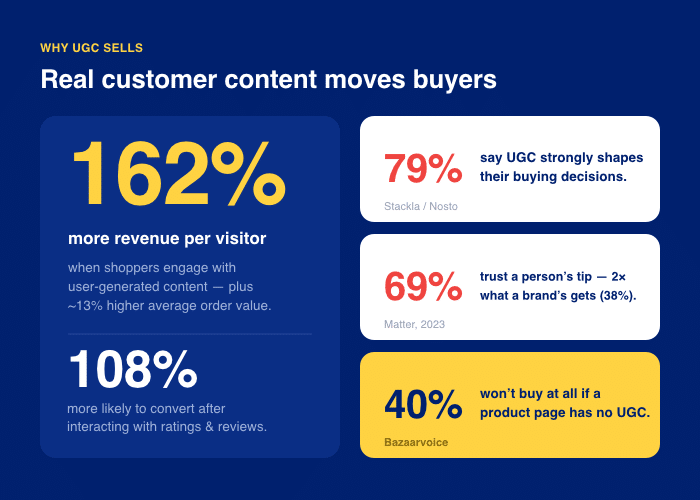
- 40% of shoppers won’t complete a purchase if there’s no UGC on the product page (Bazaarvoice)
- Engaging with UGC boosts revenue per visitor by 162% and average order value by about 13% (Bazaarvoice Shopper Experience Index, 2022)
- 79% of people say UGC highly impacts their purchasing decisions (Stackla/Nosto)
- 69% of consumers trust a recommendation from a friend, family member, or relatable person, nearly double the 38% who trust the same message from a brand (Matter Communications, 2023)
- Shoppers who interact with ratings and reviews are 108.6% more likely to convert (PowerReviews, 2023)
Key Takeaways
Short on time? Here’s what the data proves about UGC:
- UGC works at every stage of the buying journey. It builds first trust, guides the decision, and helps close the sale.
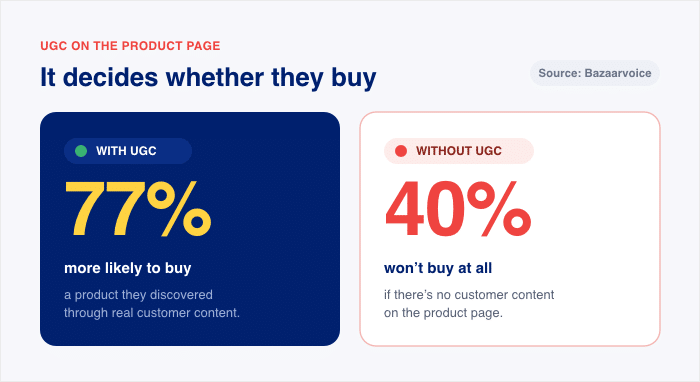
- Skipping UGC costs you sales. 40% of shoppers won’t buy without it on the product page (Bazaarvoice).
- Real-customer content beats brand content. People trust peers (69%) nearly twice as much as the same message from a brand (38%) (Matter Communications, 2023).
- Placement decides the payoff. UGC on social media isn’t enough. The conversion lift shows up when you display UGC on your website, where buying decisions happen.
Want the full picture beyond UGC specifically? Read our guide where we show important social proof statistics.
Here are the numbers you can cite, with the original source for each.
| Category | Key statistic | Source |
|---|---|---|
| Purchase influence | 79% of people say UGC highly impacts their purchasing decisions, up from 60% in 2017. | Stackla/Nosto |
| Revenue per visitor | Engaging with UGC lifts revenue per visitor by 162% and average order value by about 13%. | Bazaarvoice Shopper Experience Index, 2022 |
| Conversion (product page) | Adding reviews to product pages raises conversion rates by 10% to 30%. | Yotpo, 2024 |
| Likelihood to convert | Shoppers who interact with ratings and reviews are 108.6% more likely to convert. | PowerReviews, 2023 |
| Trust vs. brand | 69% of consumers trust a recommendation from a peer, nearly double the 38% who trust the same message from a brand. | Matter Communications, 2023 |
| Product-page abandonment | 40% of shoppers won’t complete a purchase when there’s no UGC on the product page. | Bazaarvoice |
| Visual UGC | 67% of consumers say reviews combined with customer photos or videos persuaded them to buy. | 1WorldSync, 2024 |
| Video | 66% of people say they’d be more likely to buy a product after watching a testimonial video. | Wyzowl, 2025 |
| Authenticity | 88% of consumers say authenticity matters when they decide which brands to support. | Stackla/Nosto |
| Social media influence | 76% of consumers say social media influenced a purchase in the last six months, rising to 90% among Gen Z. | Sprout Social, 2025 |
Keep this table handy for your next budget meeting. Every row ties back to an original study, so you can cite it without anyone poking holes in the sourcing.
What Is UGC and Why Do These Statistics Matter?
User-generated content is any content your customers create about your brand, not content you make yourself. That means their photos, videos, reviews, and social posts.
When a shopper tags your product in an Instagram Story or leaves a five-star review with a picture, that’s UGC. It carries weight because it comes from a real buyer, not your marketing team.
The numbers only pay off when you know where and how UGC works. That’s why this guide is sorted by the buying journey, from the first types of social proof that build trust, to the decision, to the conversion, to where you place it.
Each stat below maps to a real decision you can act on, and you’ll find the UGC strategy for your website that ties them together.
Jump to the section you need:
- Do Consumers Trust User-Generated Content?
- How Does UGC Affect Buying Decisions?
- Does UGC Increase Conversion Rates?
- Does Video UGC Perform Better Than Static UGC?
- Is UGC on Your Website More Effective Than UGC on Social Media?
- How to Get UGC onto Your WordPress Website
- Start Making Your UGC Work Where It Counts
Do Consumers Trust User-Generated Content?
Yes, and the trust gap is bigger than most marketers expect. Real customers get believed. Brands talking about themselves get doubted.
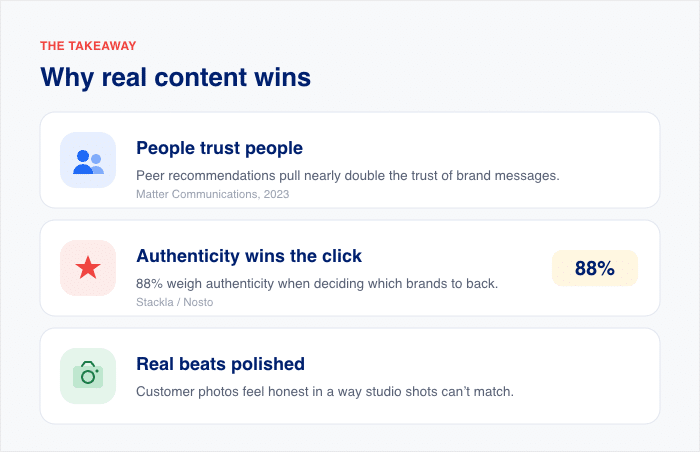
Start with what shoppers say drives their choices. 88% of consumers say authenticity matters when they decide which brands to support (Stackla/Nosto). They want proof from people like them, not a polished sales pitch.
That preference shows up clearly when you compare who people trust.
“69% of respondents are likely to trust a friend, family member or influencer recommendation over information coming directly from a brand.” — Matter Communications
Read that again. The exact same message earns nearly twice the trust when a real person delivers it instead of your brand.
This is why raw customer content beats polished brand content, and it’s why authentic content outperforms polished content in almost every test.
Here’s what that looks like in practice. Glossier, a beauty brand that launched in 2014 and grew almost entirely online, built its early following on customer content rather than polished ad campaigns.

It reposted real customers’ photos and reviews instead of studio creative, and treated every customer as a potential advocate.
Founder Emily Weiss has said the brand spent almost nothing on paid marketing in those years, crediting word-of-mouth and its community for the overwhelming majority of sales. By her own estimate, roughly 90% of early revenue came from it (Quartz, 2016).
The takeaway is simple:
- People trust people. Peer recommendations pull nearly double the trust of brand messages (Matter Communications, 2023).
- Authenticity wins the click. 88% weigh it when choosing brands (Stackla/Nosto).
- Real beats polished. Customer photos feel honest in a way studio shots can’t match.
Don’t worry if your product photos aren’t magazine-perfect. That imperfection is exactly what makes customer content believable.
How Does UGC Affect Buying Decisions?
Once shoppers trust your content, does it actually change what they buy? The data says yes, and the effect keeps getting stronger.
79% of people say UGC highly impacts their purchasing decisions, up from 60% in 2017 (Stackla/Nosto). That’s not a flat trend. UGC’s pull on buyers is rising year over year.
UGC also shapes decisions long before checkout. 48% of consumers say UGC is a great way to discover new products (Forrester). So it works at the top of the funnel too, helping people find you in the first place, not just confirming a choice at the end.
UGC Weighs Even Heavier With Younger Buyers
Younger shoppers lean on UGC more than anyone. If your customers skew Gen Z or Millennial, these numbers matter most.
- 76% of consumers say social media influenced a purchase in the last six months, rising to 90% among Gen Z (Sprout Social, 2025).
- 86% of Gen Z and 81% of Millennial shoppers are more likely to buy from e-commerce sites that display UGC (Stackla, 2021).
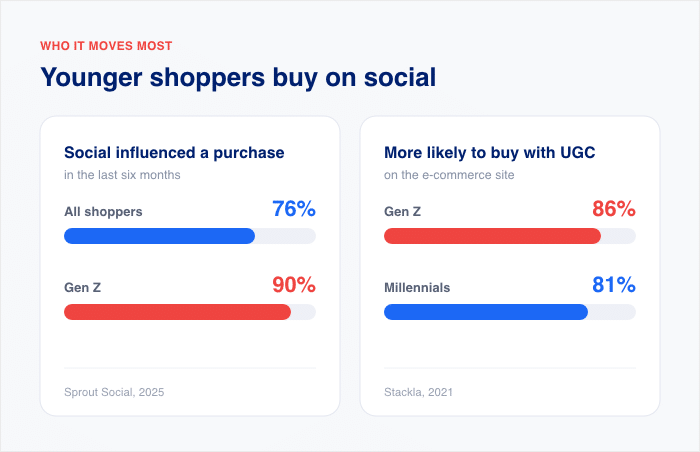
The pattern is clear. The younger the buyer, the more they expect to see real people using your product before they hand over their money.
Outdoor retailer REI built its #OptOutside campaign around resharing customer photos of real people on real trails, showing the gear in genuine use rather than in staged studio shots.
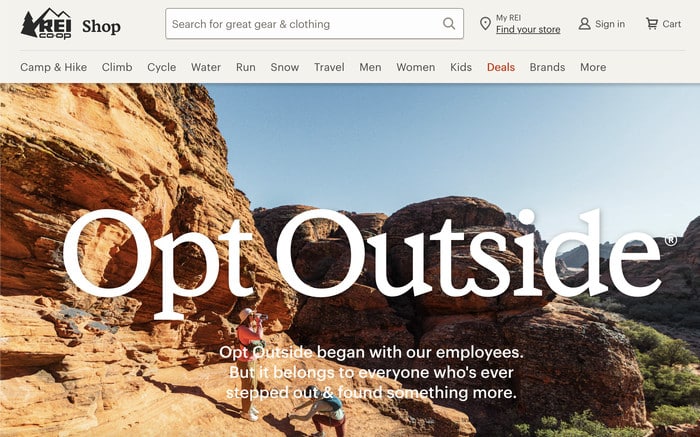
It became one of the brand’s most recognized campaigns and generated a large volume of authentic customer content, the kind of real-world proof shoppers trust more than brand-produced images.
Does UGC Increase Conversion Rates?
Yes, and this is where UGC turns from a nice-to-have into a revenue line. Trust and influence are great, but conversion is the number your leadership actually cares about. Here’s the proof you can take into that meeting.
When shoppers engage with UGC, the sales numbers move by real amounts:
- Revenue per visitor jumps 162%, and average order value climbs about 13% when shoppers engage with broad UGC like photos, videos, and reviews (Bazaarvoice Shopper Experience Index, 2022).
- Displaying reviews on product pages lifts conversion by 10% to 30% (Yotpo, 2024).
- Shoppers who interact with ratings and reviews are 108.6% more likely to convert than those who don’t (PowerReviews, 2023).
Notice what each study actually measured. Bazaarvoice tracked all kinds of customer content, while Yotpo and PowerReviews focused specifically on reviews and ratings. Together they make one point clear. Photos and reviews both belong on your product page.
That PowerReviews stat deserves its own spotlight.
“There was a 108.6% lift in conversion among shoppers who interact with ratings and reviews.” — PowerReviews
Now think about what these numbers mean for your store. A 10% to 30% conversion lift on a product page isn’t a rounding error. It’s more sales from the exact same traffic you already pay for.
The revenue-per-visitor figure works the same way. If UGC helps each visitor spend more, you earn more from every click without buying a single extra visit. That’s why adding customer content to a product page is one of the cheapest ways to grow revenue.
There’s a flip side worth knowing too. Skipping UGC on your product pages doesn’t just cost you a little lift, it costs you real buyers, and we’ll show you exactly how much in a later section.
Plus, you don’t need a huge library to start. Even a handful of real customer photos and reviews on your top product page can move these numbers in your favor.
Does Video UGC Perform Better Than Static UGC?
Not exactly, and this is where a lot of guides get it wrong. The real winner isn’t video over photos. It’s visual UGC, photo or video, over plain text and polished brand content.
Start with the stat that proves it. 67% of consumers say reviews with customer photos or videos have persuaded them to buy (1WorldSync, 2024). When a shopper can see the product in a real person’s hands, they trust it more.
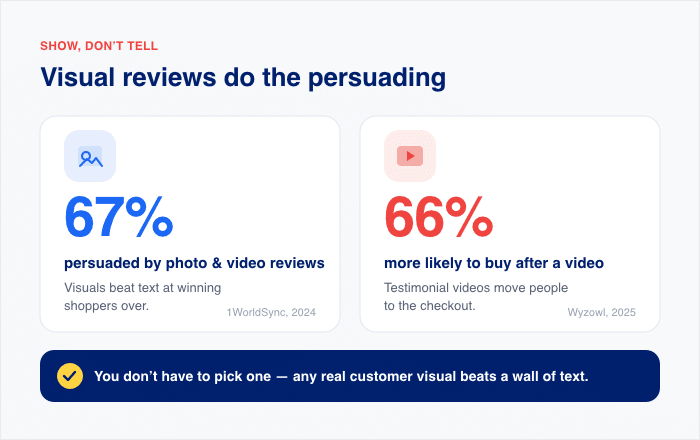
Video adds to that pull. 66% of people say they’d be more likely to buy a product after watching a testimonial video (Wyzowl, 2025).
One thing to note on that figure: Wyzowl measured testimonial videos broadly, not strictly customer-made ones. So treat it as supporting evidence, not proof that video beats photos.
Now think about the formats your customers already create. Unboxing clips, quick demos, and before-and-after shots all show your product doing its job. That kind of proof is hard to fake, and shoppers know it.

Skincare brand CeraVe became a fixture of skincare TikTok, where customers and creators post their own before-and-after routines and honest product demos rather than polished studio ads.
That kind of everyday, real-results content is exactly the visual UGC shoppers trust, and it’s the same type of content any brand can collect from its own customers.
That’s why TikTok and YouTube customer videos are worth capturing, right alongside photo reviews. They’re some of the most persuasive UGC types you can put in front of a buyer.
A few honest customer photos on your product page already do most of the heavy lifting, and you can add video as it comes in.
Is UGC on Your Website More Effective Than UGC on Social Media?
Yes, and this is the part most guides skip. Every stat above only pays off when UGC sits where people buy. That means your product page, not your Instagram grid.
Here’s the number that makes the case.
“When shopping on a brand or retailer’s website, 40% of shoppers won’t purchase if there isn’t UGC on the product page.” — Bazaarvoice.
Almost half of your buyers look for real customer content at the exact moment they decide, and they walk when it isn’t there.
Now think about where most brands keep their best customer photos. They post them on social media, get a few likes, and move on. That content reaches a slice of your followers, not the shoppers sitting on your product page with a card in hand.
This is the gap that quietly costs you sales. Collecting UGC and displaying UGC are two different jobs.
- Collecting fills your camera roll with great customer photos and videos.
- Displaying puts that proof in front of buyers at the add-to-cart moment.
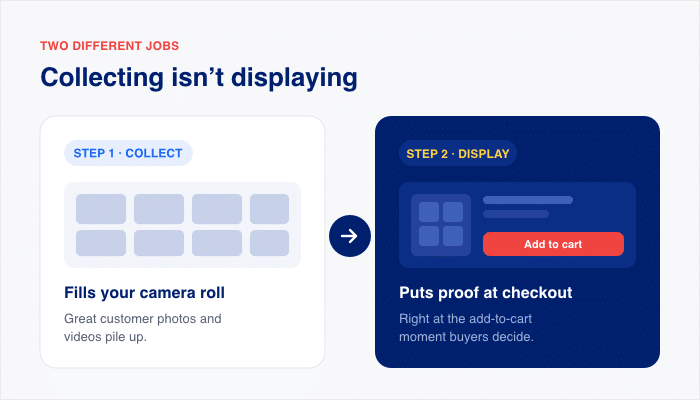
Social media is built for the first job. It’s terrible at the second. A shopper deciding on your product isn’t scrolling your feed for reassurance. They’re staring at your product page, looking for a reason to trust the purchase.
On-site UGC also keeps people around longer and brings them back. Brands that add UGC to their site report 3x more repeat website visits, and visitors spend more than twice as long on pages that show UGC (Emplifi, 2025).

That extra attention matters most because trust is exactly what’s missing at checkout. 19% of shoppers abandon their cart because they don’t trust the site with their card info (Baymard, 2024).
Real customer photos and reviews on the page close that trust gap right where it costs you the sale.
If you run an ecommerce store, this is where shoppable Instagram feeds for product pages earn their keep. They pull your customer photos out of the social feed and place them next to the buy button, where the 40% who need proof will actually see it.

UGC on your website beats UGC on social because it meets shoppers in the purchase context, not just the scroll.
This isn’t an either-or decision. Keep posting on social, and put that same content to work on your site too. So how do you actually move it there? The next section walks you through it.
How to Get UGC onto Your WordPress Website
Ready to put your customer content where buyers decide? Your best customer photos live on social media, far from your product pages.
You need a way to move that content onto your site, and keep it fresh without copying and pasting every new post. Don’t worry, you don’t need a developer or manual curation for this.
With my experience at Smash Balloon helping businesses display customer content, here’s the setup I recommend to solve exactly that.
Pull Instagram Photos Straight onto Your Pages
Instagram Feed Pro pulls customer-tagged Instagram posts and branded-hashtag feeds straight onto any WordPress page.
It handles both photo and video UGC, so every real customer image lands right where shoppers see it.
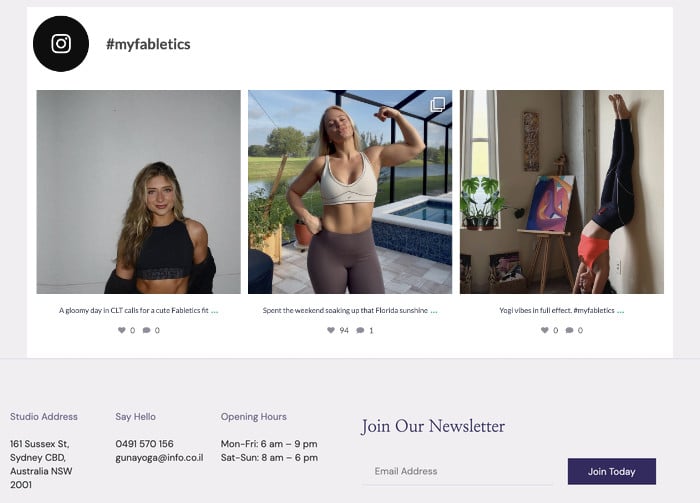
Once you connect your account and pick a hashtag or tagged-post source, the feed auto-updates on its own. You set it up once, and new customer content flows in with no manual curation.
Put Customer Photos Next to Your Buy Button
Instagram Feed Pro pulls tagged posts and hashtag feeds onto any WordPress page, then updates on its own as new customer content comes in.
Show UGC Where Buyers DecideBring Customer Videos Onto Your Product Pages
TikTok Feed Pro does the same for video UGC from TikTok. It pulls customer clips like unboxings and demos onto your WordPress pages, and updates automatically as new videos come in.

That’s the kind of video proof that moves buyers. In fact, 66% of people say they’re more likely to buy after watching a testimonial video (Wyzowl). Now that proof works on your site instead of sitting in a social feed.
Want customer videos next to your buy button? Get TikTok Feed Pro today and put that proof to work.
Expert Tip: Looking for a full step-by-step guide? Here’s how to create a UGC gallery on your WordPress website from start to finish.
Frequently Asked Questions
What does UGC stand for?
UGC stands for user-generated content, which is any content your customers create about your product instead of your brand. On a website, the most common formats are customer photos, video reviews, star ratings, written reviews, and tagged social posts. These are the real-world proof shoppers look for before they buy.
What percentage of consumers trust UGC?
Consumers trust UGC far more than brand-made content. 79% of people say UGC highly impacts their purchasing decisions, up from 60% in 2017 (Stackla/Nosto), and 88% say authenticity matters when choosing which brands to support (Stackla/Nosto). Trust in peers over brands is just as clear: 69% trust a recommendation from a peer, versus 38% for the same message from a brand (Matter Communications, 2023).
Does UGC actually increase sales?
Yes, UGC increases sales, and the lift is measurable. Shoppers who engage with UGC drive 162% more revenue per visitor and about 13% higher average order value (Bazaarvoice Shopper Experience Index, 2022), while displaying reviews on product pages lifts conversion by 10% to 30% (Yotpo, 2024). Shoppers who interact with ratings and reviews are also 108.6% more likely to convert than those who don’t (PowerReviews, 2023).
Where should UGC be displayed for maximum impact?
UGC works best on your product pages, right before the add-to-cart button. That’s the exact moment buyers look for proof, and 40% of shoppers won’t complete a purchase if there’s no UGC on the product page (Bazaarvoice). Your own website beats social platforms here, because a shopper deciding on your product is on your page, not scrolling your feed.
How do I collect and display UGC on my WordPress website?
Two plugins pull customer content onto your pages automatically. Instagram Feed Pro brings tagged posts and hashtag feeds onto any WordPress page, so get Instagram Feed Pro to show customer photos where buyers decide. For video, TikTok Feed Pro pulls clips like unboxings and demos and updates as new ones come in.
Start Making Your UGC Work Where It Counts
You’ve seen what customer content can do. Now the only question left is where you put it to work.
Here’s the shift that changes everything: your best proof shouldn’t sit on social media, seen by a fraction of your followers and gone by tomorrow. It belongs on your product page, next to the buy button, at the exact moment a shopper is deciding whether to trust you.
The best part is that you don’t need a developer, a redesign, or hours of copying and pasting to make it happen. You just need to bring the content you already have onto the pages that matter most.
Ready to turn customer content into on-page proof?
Get Instagram Feed Pro today and start displaying UGC right where buyers decide.