Social Wall
  Feed Analytics

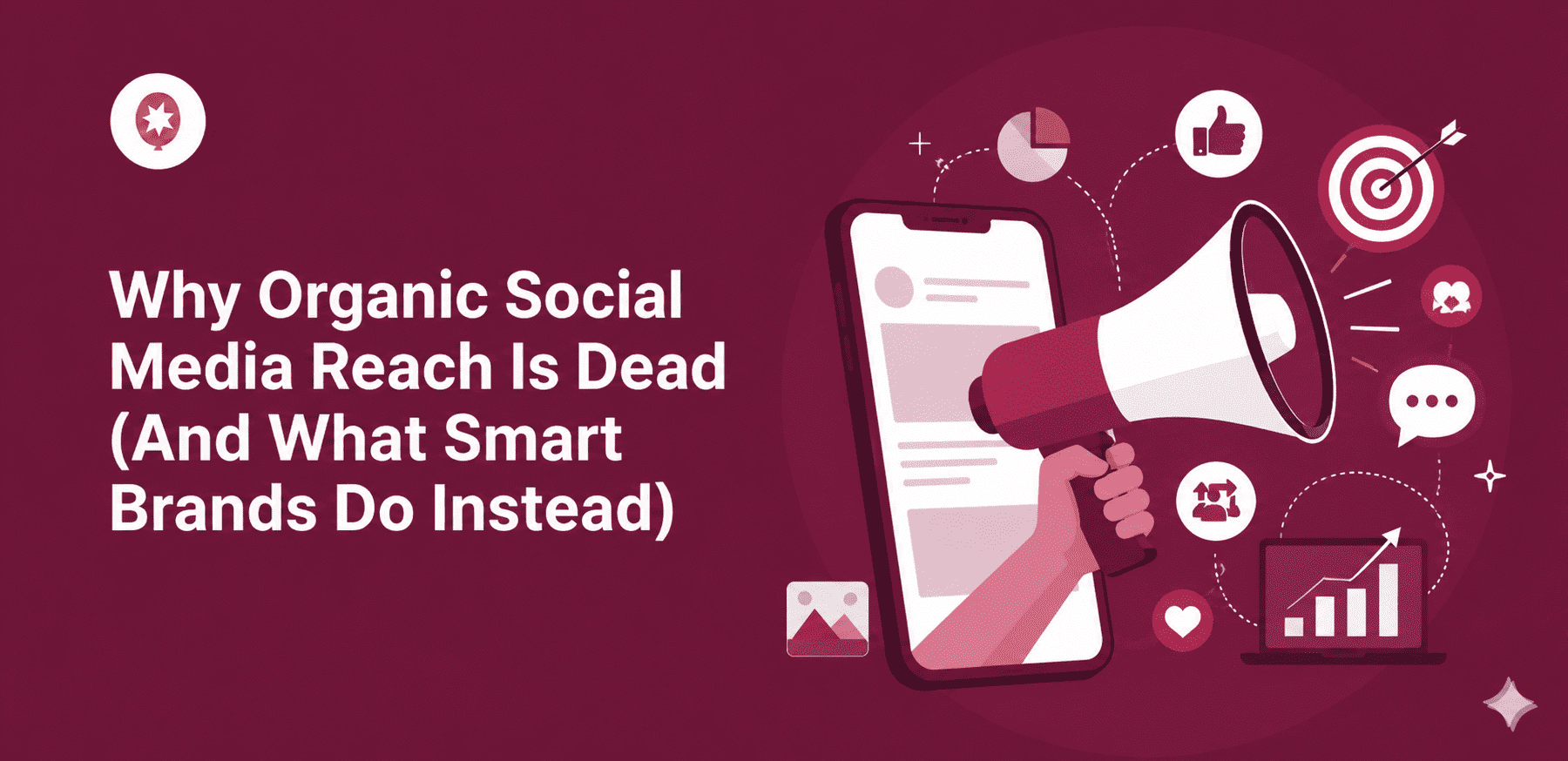
If you’ve been posting consistently on social media and watching your reach quietly shrink, you’re not imagining it.
Organic reach has been declining for years, and at this point it’s less of a trend and more of a permanent feature of how social platforms work.
I manage content across multiple social channels as part of my role at Smash Balloon, and I’ve watched this happen up close.
You spend an hour on a post, hit publish, and reach a fraction of the people who actually follow you. You do everything “right” and still see the numbers drop.
So let’s talk about what’s actually happening, where each platform stands in 2026, and what the brands that are still growing are doing differently.
In This Article
- What Is Organic Social Media Reach?
- Why Organic Reach Collapsed
- Where Organic Reach Stands in 2026
- What Counts as "Good" Organic Reach in 2026?
- What Smart Brands Are Doing Instead
- How Smash Balloon Helps You Own Your Social Content
- The Platform You Actually Own
- How to Measure Your Organic Reach
- FAQ
- Start Building on Channels You Actually Own
What Is Organic Social Media Reach?
Organic social media reach is the number of unique people who see your content without you paying to promote it — your followers, plus anyone who sees the post because someone shared it or the algorithm surfaced it in a non-follower’s feed.
It sounds simple, but there’s an important distinction most platforms blur:
| Term | What It Means |
|---|---|
| Reach | Number of unique people who saw your post |
| Impressions | Total times your post appeared on a screen (same person can count multiple times) |
| Engagement rate | Percentage of people who interacted (liked, commented, shared, saved) |
Platforms tend to report impressions more prominently because impressions look better.
When marketers talk about organic reach declining, they mean reach specifically: fewer unique people seeing your posts, regardless of how many times those posts appeared.
Why Organic Reach Collapsed
This wasn’t an accident. Two things happened at once.
1. Platforms monetized reach
Facebook, Instagram, and TikTok all launched free.
The business model in each case: attract users, grow the audience, then charge businesses for access to that audience through paid ads. Organic reach is essentially what they’re selling.
Once you’ve built an audience, platforms have limited incentive to show your content for free when they can charge you for the same distribution.
2. Content saturation made it worse
The number of posts competing for feed space has multiplied dramatically.
In 2012, a Facebook post had relatively little competition for your followers’ attention. By 2026, the average user follows hundreds of pages, friends, groups, and advertisers, all competing for the same feed. Even if the algorithm were neutral, reach would shrink from dilution alone.
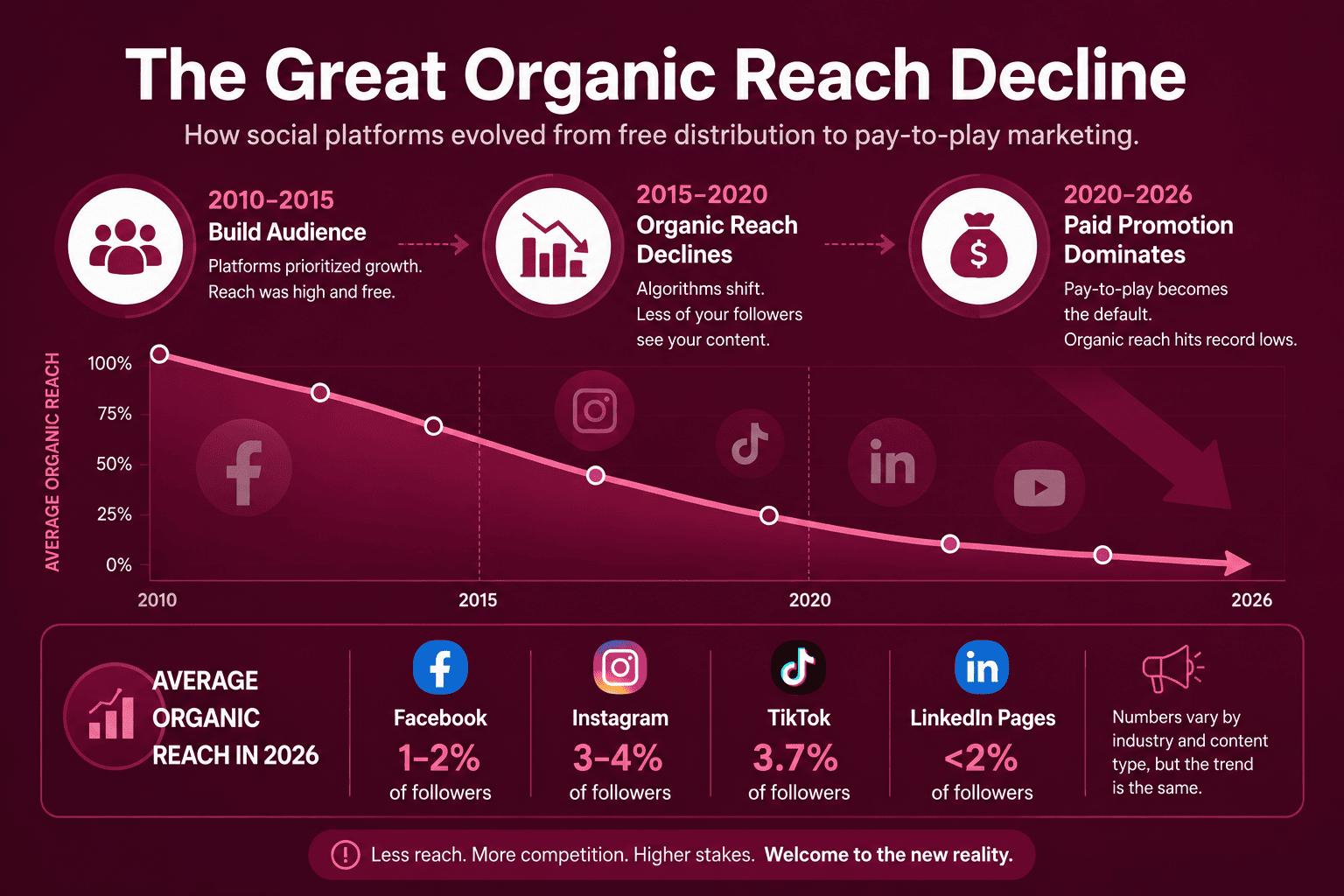
According to Smash Balloon’s social media marketing statistics research, Facebook organic reach dropped from 16% in 2012 to under 2% today for most business pages.
On a page with 10,000 followers, that’s roughly 200 people seeing any given post.
Instagram, TikTok, LinkedIn, and YouTube all follow the same direction: at different speeds and for slightly different reasons.
Where Organic Reach Stands in 2026
Here’s the full platform picture, including what content formats are still getting distribution.
| Platform | Avg. Organic Reach | Best Format Now | Key Watch-Out |
|---|---|---|---|
| 1–2% | Reels, native video | Groups outperform Pages significantly | |
| 3–4% | Reels with original audio | Story reach drops if followers don’t regularly engage | |
| TikTok | 3–4% | Short-form original video | High upside, very inconsistent baseline |
| LinkedIn (company) | ~2% | Text posts, carousels | Performs similarly to Facebook Pages |
| LinkedIn (personal) | 20–30% | Text posts, carousels | Only applies to individual profiles, not brand pages |
| YouTube | Search-driven | Long-form + Shorts | Subscribers ≠ views; search optimization matters more |
- Organic reach for business Pages: 1–2%
- Video and Reels outperform static posts, but rarely crack 5% consistently
- Groups significantly outperform Pages — Facebook has repositioned Groups as a community tool, not a broadcast channel
- If you’re only posting to a Page and seeing flat reach, the format is part of the problem
- Business account average: 3–4%
- Reels with original audio get the best early distribution — the algorithm favors content that keeps people on the platform
- Story reach is higher for highly engaged accounts, but drops sharply when followers are passive
- Hashtags have lost most of their amplification value in 2025–2026
TikTok
- Average: 3–4% — but the range is enormous
- Algorithm is more content-driven than follower-driven, so any video can break out regardless of account size
- The trade-off: the baseline is unpredictable. What works one week rarely replicates consistently
- Best for: high upside, difficult to build a steady strategy around
- Company Pages: ~2% (similar to Facebook Pages)
- Personal profiles: 20–30% of connections — the outlier on this list
- Accounts that do well on LinkedIn are built around individual voices (founders, executives, practitioners) posting as themselves, not as the brand
YouTube
YouTube behaves more like a search engine than a social network. Subscribers don’t drive views the way followers used to drive reach elsewhere. What actually matters:
- Watch time (percentage of video watched)
- Click-through rate from thumbnails in search/suggested
- Search optimization (title, description, tags)
Understanding the relationship between social media and SEO is especially useful for YouTube. A well-optimized video can drive traffic for years after it’s published, which is something no Instagram post or Facebook update can do.
What Counts as “Good” Organic Reach in 2026?
This question gets searched constantly and almost never answered directly. Here’s a practical benchmark by platform:
| Platform | Average | Strong |
|---|---|---|
| Facebook Pages | 1–2% | 5%+ per post |
| Instagram (business) | 3–4% | 8%+ per post |
| TikTok | 3–4% | Hard to benchmark — use your median |
| LinkedIn company | 2–3% | 5%+ |
| LinkedIn personal | 20%+ | Anything below 10% is a signal of low recent engagement |
One important reframe: reach rate alone doesn’t tell you much. A post that reaches 4% of your audience and drives 20 website visits is more valuable than one that reaches 8% and gets scrolled past.
The metrics that actually matter after reach:
- Profile link clicks
- Website visits from social (track in GA4)
- Saves and shares (stronger algorithmic signals than likes)
- Conversion actions (sign-ups, purchases, DMs)
What Smart Brands Are Doing Instead
Brands that are still growing have made a strategic shift: treat your website as the hub and social media as one spoke, not the whole wheel.
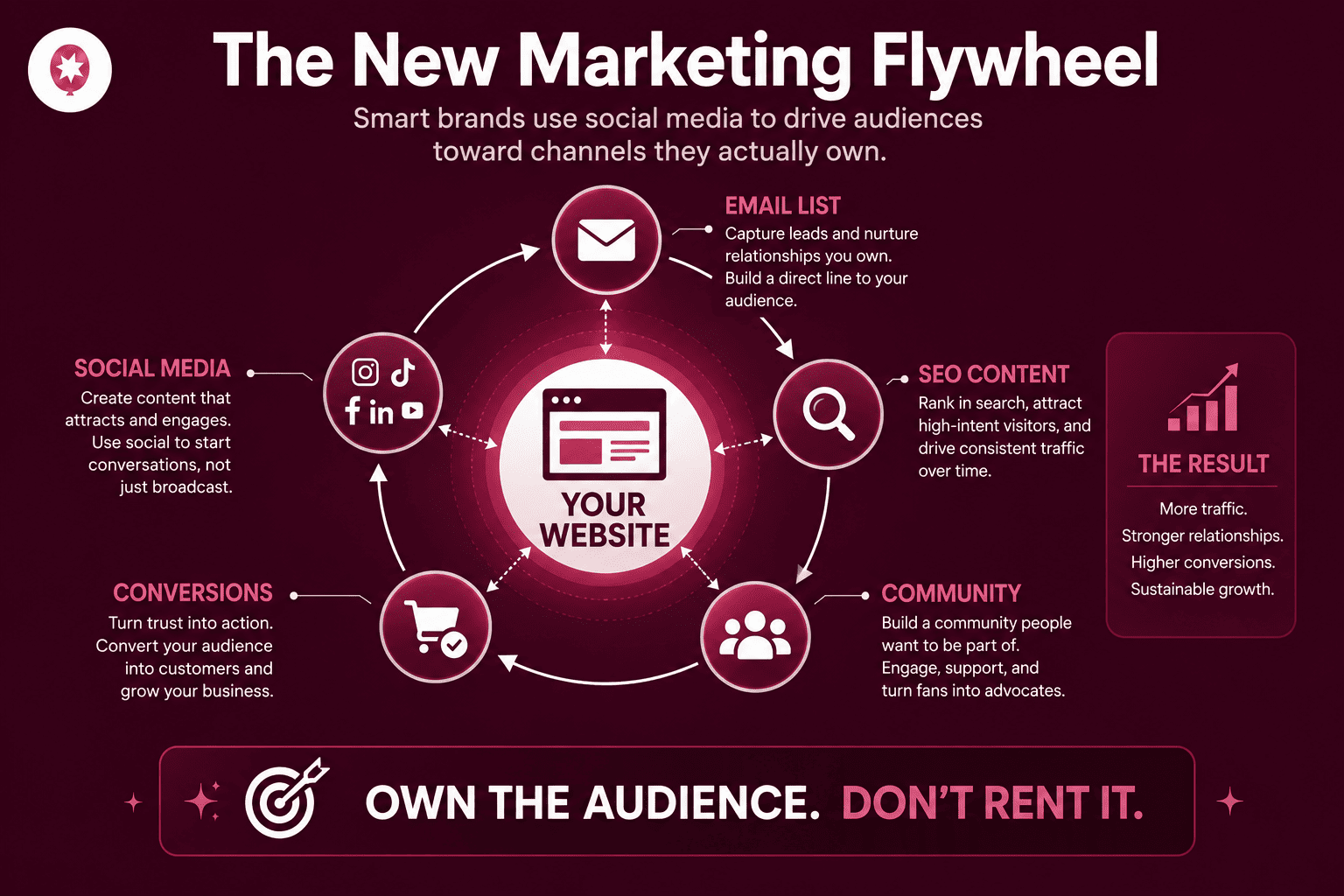
Here’s what that looks like in practice.
1. Build audience on channels you own
The core problem with social media audiences: they’re rented.
| Asset | Who Owns It |
|---|---|
| Instagram followers | |
| Facebook Page likes | Meta |
| TikTok followers | TikTok |
| Email list | You |
| Website traffic | You |
When Instagram changes its algorithm, when TikTok faces regulatory risk, or when a platform loses relevance, your email list doesn’t care.
The brands that survived the 2015 Facebook reach collapse were the ones who had built email lists alongside their Pages.
Building a list doesn’t require a separate strategy. It means treating every social post as a chance to move someone from a rented platform to a channel you own: a newsletter, a lead magnet, a free resource linked in bio.
2. Optimize for search, not just social
A YouTube video optimized for search can drive views three years after it was published. A blog post targeting the right keyword compounds over time. A social post is essentially gone from most feeds within hours.
Improving your social media marketing increasingly means connecting social and search content rather than treating them as separate strategies.
A topic that gets strong engagement on Instagram is often worth building a search-optimized article around. The social post tests whether people care. The article captures long-term traffic.
3. Let your customers extend your reach
User-generated content (UGC) is one of the few forms of organic social content that consistently outperforms branded content on reach. Why: when a customer posts about your brand, their followers see it — an audience you’d otherwise have no access to.
Social proof extends reach in a way algorithmic tricks can’t. Strategies that generate it:
- Branded hashtag campaigns
- Review request follow-ups after purchase
- Photo contests tied to a product or experience
- Resharing customer content with credit
None of these cost money. They just require being intentional about inviting participation instead of broadcasting.
4. Invest in community, not just content
Organic reach from broadcast content is declining. Organic reach from genuine community engagement is more durable.
Brands that invest time in:
- Responding to every comment, not just the easy ones
- Starting conversations rather than just posting announcements
- Participating in DMs and relevant groups
- Engaging with other accounts in their space
…consistently hold their reach better than brands that post and disappear. Every major platform’s algorithm rewards accounts that drive real engagement. A post with 10 thoughtful comments outperforms one with 100 passive likes in early distribution.
5. Bring social content back to your website
Social content that only lives on the platform depends on the platform’s algorithm to show it.
The same content embedded on your website works on your terms, which are visible to every visitor, regardless of what the algorithm decides that day.
Embedding your social media feeds on your WordPress site turns every page of your site into proof of activity:
- Product pages show your latest Instagram posts
- Homepages show live customer reviews from Google and Facebook
- About pages display your YouTube channel or TikTok feed
Visitors see you’re active without you needing the algorithm’s cooperation to reach them.
How Smash Balloon Helps You Own Your Social Content
This is where it’s worth explaining what Smash Balloon actually is, because it’s directly relevant to everything above.
Smash Balloon is a suite of social media WordPress plugins built specifically for WordPress sites.
It connects your site to your social media accounts and displays your feeds directly on your pages. Automatically, without you touching anything after setup.
Here’s why that matters in the context of organic reach:
When you post on Instagram, that content lives on Instagram’s platform and reaches people only if Instagram’s algorithm decides to show it.
When you embed that same feed on your WordPress site using Smash Balloon, every visitor to your website sees your latest posts. No algorithm. No paid promotion. Just your content, working on a platform you control.
What Smash Balloon includes:
| Plugin | What It Displays |
|---|---|
| Instagram Feed Pro | Photos, Reels, Stories, tagged posts, shoppable feeds |
| Facebook Feed Pro | Page posts, albums, events, reviews |
| YouTube Feed Pro | Channel videos, playlists, live streams, Shorts |
| TikTok Feeds Pro | TikTok videos embedded on your site |
| Twitter/X Feed Pro | Tweets, profile feeds, hashtag feeds |
| Reviews Feed Pro | Google, Yelp, Trustpilot, TripAdvisor, Facebook reviews |
| Social Wall | All of the above in one unified multi-platform feed |
Each plugin installs inside WordPress in minutes, no code required.
Feeds update automatically as you post to social.
And because it’s a WordPress-native plugin (not a SaaS tool that injects an iframe), feeds load faster, don’t send visitor data to a third-party server, and keep displaying even during social platform outages thanks to built-in backup caching.
Smash Balloon is trusted by 1.75 million+ active WordPress users including brands like Coca-Cola, Chick-fil-A, and Indeed, with 6,000+ five-star reviews across all plugins.
If organic reach feels like a losing battle, Smash Balloon is the practical alternative: your social content, displayed on your website, reaching every visitor whether or not the algorithm cooperates.
The Platform You Actually Own
Social platforms set the algorithm, change the rules, and sell your audience back to you.
Your website doesn’t do any of that.
The most practical way to close the gap between “posting on social” and “building something durable” is pulling that content onto your site.
If you’re posting consistently on Instagram, Facebook, YouTube, or TikTok, that content is already created.
Embedding it on your website means visitors see your real, updated social activity on a platform you control, without requiring a single additional post.
Smash Balloon Social Wall is the multi-platform option. It pulls all your feeds into one unified, customizable wall on your WordPress site, included as part of the All Access Bundle. Individual plugins start at $49/year per site. Either way, setup takes about 5 minutes.
How to Measure Your Organic Reach
Before you can improve reach, you need to know what you’re actually measuring. Here’s where to find reach data on each platform:
| Platform | Where to Find Reach Data |
|---|---|
| Meta Business Suite → Posts → Reach column | |
| Meta Business Suite → Posts → Accounts Reached | |
| TikTok | TikTok Studio → Content → each video’s analytics |
| Post → View Analytics → Unique impressions | |
| YouTube | YouTube Studio → Content → Reach tab |
For a cross-platform view without checking five dashboards, dedicated social media analytics tools aggregate these numbers and let you track trends over time.
What to track week over week:
- Reach rate per post (reach ÷ followers)
- Engagement rate (engagements ÷ reach)
- Website clicks from social (in GA4 under Traffic → Social)
- Email sign-ups attributed to social traffic
FAQ
What is a good organic reach rate on social media?
It depends on the platform. On Facebook, 2% is average for business Pages; anything above 5% on a post is strong. Instagram business accounts average 3–4%, with above 8% being genuinely good. LinkedIn company Pages average 2–3%, while personal profiles can see 20–30% of connections. TikTok varies too widely for a single benchmark. Track your median across 30+ posts rather than focusing on individual videos.
Why has organic reach declined so much?
Two reasons working together: platforms monetize reach (they sell access to your audience through paid ads, so distributing your content for free works against their business model), and content saturation (far more posts are competing for the same feed space than in 2012). Even if algorithms were neutral, reach would decline from volume alone.
Is organic reach actually zero now?
Not zero, but low enough that it can’t anchor a distribution strategy. Facebook business Pages average 1–2% per post. Instagram averages 3–4%. TikTok sits around the same. The trend has been consistently down for over a decade, and platforms have no financial incentive to reverse it.
Does posting more often help organic reach?
Frequency alone doesn’t move reach, engagement rate does. Every major platform’s algorithm rewards content that gets comments, shares, saves, and watch time. Posting daily low-engagement content can actually suppress your distribution over time. Fewer high-quality posts consistently outperform high-frequency posting of average content.
Should I stop investing in organic social media?
No, but the goal should shift. Organic social is genuinely useful for brand awareness, community building, and staying visible to existing followers. It’s a weak primary channel for lead generation or traffic when measured against email, SEO, or paid. Use it for what it does well and build owned channels alongside it.
How do you increase organic reach without paying?
The highest-impact moves: prioritize the formats each platform currently distributes best (Reels on Instagram and Facebook, short-form video on TikTok, text posts and carousels on LinkedIn), post content that drives engagement in the first 30–60 minutes after publishing, and build reciprocal engagement with accounts in your space. None of these reverse the long-term trend, but they help you extract more from the reach you do have.
Start Building on Channels You Actually Own
The brands still growing from social media in 2026 aren’t the ones that cracked the algorithm. They’re the ones that stopped depending on it.
Organic reach will keep declining.
The platforms have every financial incentive to make sure of it. The practical response isn’t to quit social. It’s to build your website and email list in parallel, so your growth doesn’t live or die by what Instagram decided to do with your post today.
If you’re on WordPress, Smash Balloon gives you an easy way to start.
It pulls your social feeds from every major platform, embeds them anywhere on your site, and takes about 5 minutes to set up. Individual plugins start at $49/year, or get every plugin in the All Access Bundle.
Get Smash Balloon All Access Bundle