Social Wall
  Feed Analytics

If you’ve ever wondered whether online reviews affect your bottom line, the short answer is yes.
With my experience at Smash Balloon helping businesses display social proof on their websites, I’ve seen firsthand how a single well-placed review feed can shift how visitors behave.
The problem is, online marketing is full of myths. You’ve probably heard that reviews matter, that social proof builds trust, that star ratings affect your Google ranking.
Some of that is true. Some of it is overstated. And without real data, it’s nearly impossible to know where to focus your time.
That’s exactly why I dug in. I pulled verified stats from BrightLocal, Nielsen, Harvard Business School, and more to separate hard facts from popular guesses.
I wanted answers to the questions most roundups never bother to address, like how many reviews you need, which platforms drive the most results, and why where you show reviews matters just as much as having them at all.
Below are 35 social proof statistics, each with a plain-English explanation of what it means for your website.
- The Quick Answer: Yes, Social Proof Moves the Needle
- Review and Rating Statistics
- Trust and Credibility Statistics
- The Real Cost of Having No Reviews (Or Ignoring Them)
- Conversion Rate Statistics
- Platform-Specific Social Proof Statistics
- Social Media as Social Proof Statistics
- What These Stats Mean for Your Website
- Start Displaying Reviews on Your Website Today
- More Online Marketing Guides and Tutorials
The Quick Answer: Yes, Social Proof Moves the Needle
Before we break this down section by section, here are the five numbers that reframe everything. These stats alone justify the rest of the read.
- Testimonials on a landing page can increase conversions by up to 34% [VWO Case Studies]
- A 1-star increase on Yelp correlates with a 5-9% increase in revenue. [Harvard Business School / Michael Luca, 2016]
- Shoppers who interact with ratings and reviews see a 108.6% boost in conversion [PowerReviews, 2023]
- 96% of consumers say ratings and reviews are the most influential factor in their purchase decisions [PowerReviews, 2025]
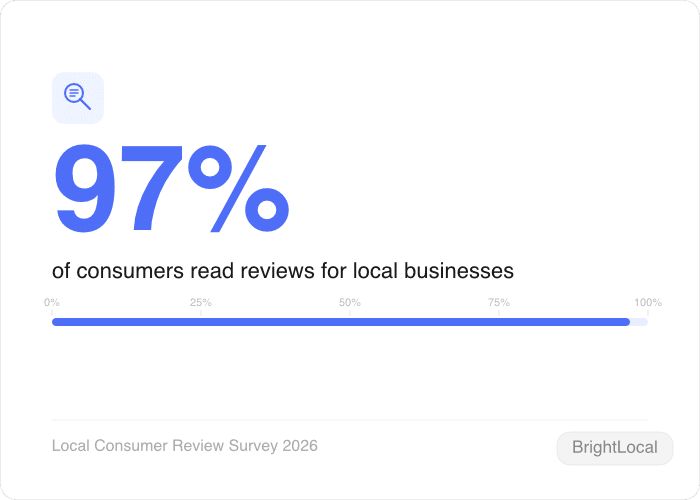
- 97% of consumers read online reviews for local businesses [BrightLocal, 2026]
The rest of this post unpacks exactly where these numbers come from, what they mean for your site, and what to do about them.
Review and Rating Statistics
Let’s start with the big picture: How many people actually read reviews, and how much weight do they carry?
- Stat #1: 97% of consumers read online reviews for local businesses. [BrightLocal, 2026]
That means nearly every person who lands on your Google Business Profile, Yelp listing, or website is actively looking for reviews. If you don’t have them, your buyers are leaving without the confidence they need to say yes.
- Stat #2: 99.9% of shoppers read reviews at least sometimes before making a purchase. [PowerReviews, 2021]
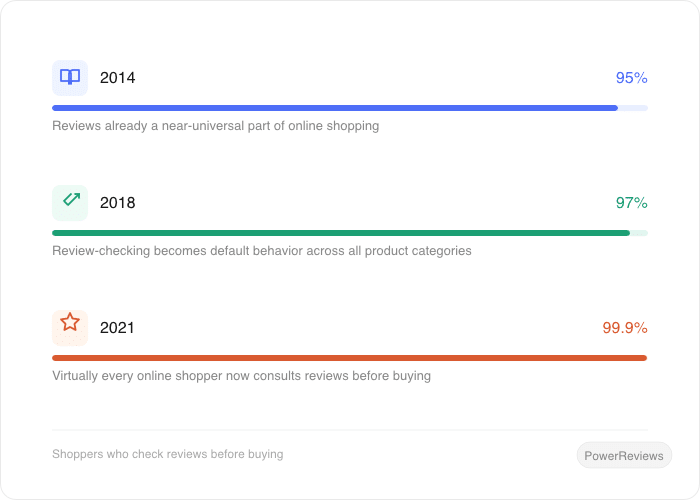
This means your buyers are checking reviews whether they’re spending $10 or $1,000. Put another way, reviews are part of every buying journey now, not just high-stakes purchases.
- Stat #3: Consumers read an average of 10 reviews before feeling they can trust a local business. [BrightLocal Consumer Review Survey, 2020]
Your buyers are doing real homework before they commit. If you only have two or three reviews, you may be losing customers who wanted to feel confident but didn’t have enough to go on.
- Stat #4: 85% of consumers only consider reviews written in the past 3 months relevant. [BrightLocal, 2020]
This means your older reviews are worth less than you think. A glowing review from two years ago does little to reassure a buyer who wants proof your business is still delivering today.
- Stat #5: 76% of consumers always or regularly read reviews when browsing for local businesses. [BrightLocal, 2023]
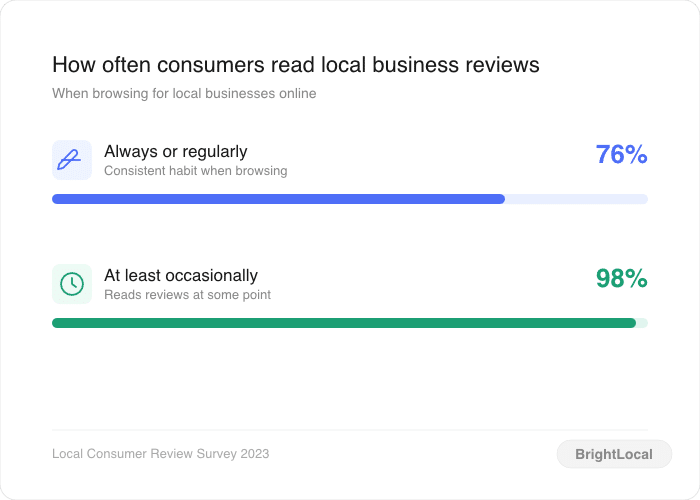
Your buyers aren’t occasionally glancing at reviews. They’re making it a habit. If your reviews section looks thin or outdated, those buyers are already comparing you to competitors who look more credible.
- Stat #6: 83% of consumers who were asked to leave a review went on to write one. [BrightLocal, 2026]
Most happy customers won’t leave a review on their own, but they will if you ask them directly. This means your review count is less about luck and more about having a consistent system for making the ask.
- Stat #7: 68% of consumers will only use a business with a rating of 4 stars or higher. [BrightLocal, 2026]
That 4-star threshold matters more than the total number of reviews you have. Your buyers are filtering businesses out before they even click, so protecting your average rating is just as important as growing it.
- Stat #8: 57% of shoppers read reviews while shopping in-store, not just before they buy online. [PowerReviews, 2021]
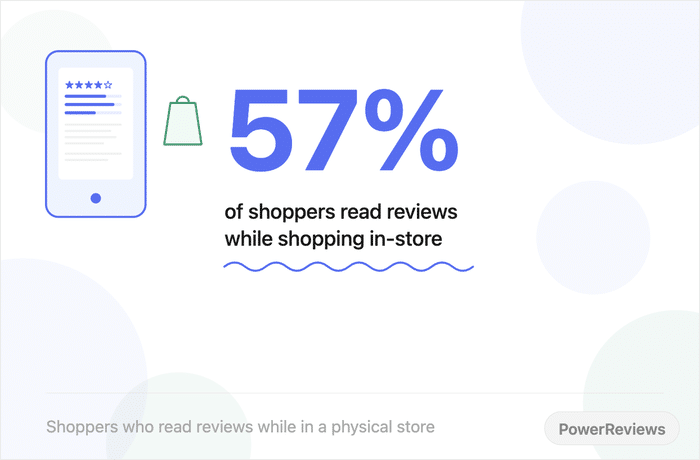
Reviews don’t stop at your checkout page. Your buyers are reading reviews on their phones while standing in your store, comparing options before they decide. This means social proof shapes decisions at every stage of the buying process.
- Stat #9: 96% of consumers say ratings and reviews are the most influential factor in their purchase decisions, ranking above recommendations from friends and family. [PowerReviews, 2025]
A stranger’s review carries the same weight as advice from a close friend. This means a well-reviewed business has built-in credibility before a buyer ever speaks to anyone on your team.
The good news is, you don’t need hundreds of reviews to start seeing results. Here’s what the data says about how many you actually need.
How Many Reviews Does a Business Actually Need?
Most business owners assume they need dozens of reviews before buyers take notice. The data says otherwise.
BrightLocal found that consumers need to see 10 recent reviews on average before they feel comfortable trusting a local business.
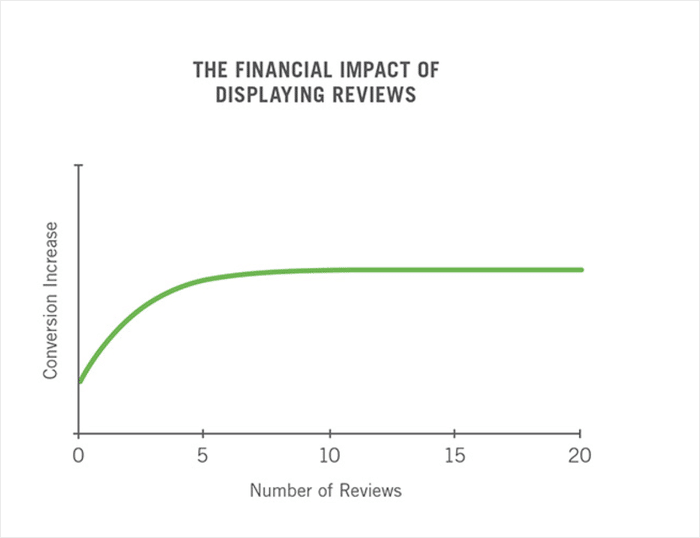
That’s a threshold most businesses can hit within weeks once they start asking consistently. A variable most owners overlook is recency, not quantity.
A business with 200 reviews from three years ago may be trusted less than a competitor with 15 reviews from this month. Buyers want proof that your business is still delivering, not a historical record of past performance.
Here’s what that means in practice:
- 10 or more recent reviews is your minimum viable starting point
- Recency beats volume once you’ve crossed that threshold
- A steady flow of new reviews outperforms a one-time burst followed by silence
- Consistent star ratings build trust faster than a high review count with wide swings
Don’t worry, reaching that threshold is faster than most business owners expect, especially once you have a simple system for asking.
Trust and Credibility Statistics
Here’s what’s quietly killing conversions even when your traffic looks healthy.
Buyers are more skeptical than ever before, and they’re scanning for signals that your reviews are real, recent, and genuinely earned.
These numbers show exactly what they’re checking and what makes them click away.
- Stat #10: Purchase likelihood peaks between 4.0 and 4.7 stars and actually drops as ratings approach a perfect 5.0. Too-good-to-be-true scores cost conversions. [Medill Spiegel Research Center, 2025]
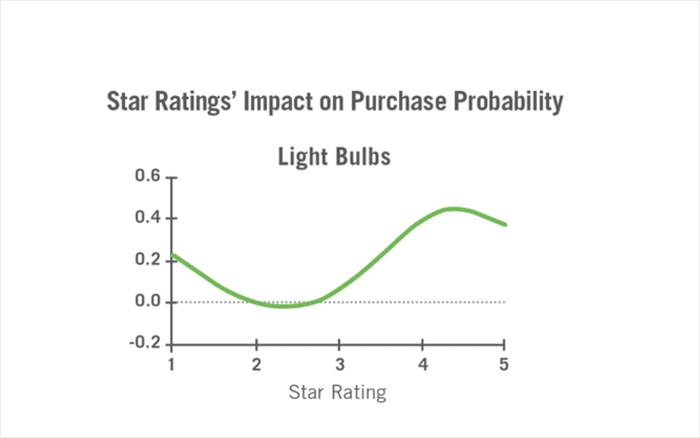
What this means for you: A flawless five-star record raises red flags for buyers, signaling that someone may have filtered out the critical reviews rather than actually earning perfection.
- Stat #11: Consumers’ intent to purchase doubles when they see a brand respond to a negative review. [Bazaarvoice, 2025]
What this means for you: Every reply you write could be read by potential buyers who haven’t purchased yet, which makes responding to reviews one of the most visible trust signals you control.
To make the most of this, check out this guide with the best ways of responding to negative reviews.
- Stat #12: 74% of consumers only trust reviews written in the last 3 months. [BrightLocal, 2026]
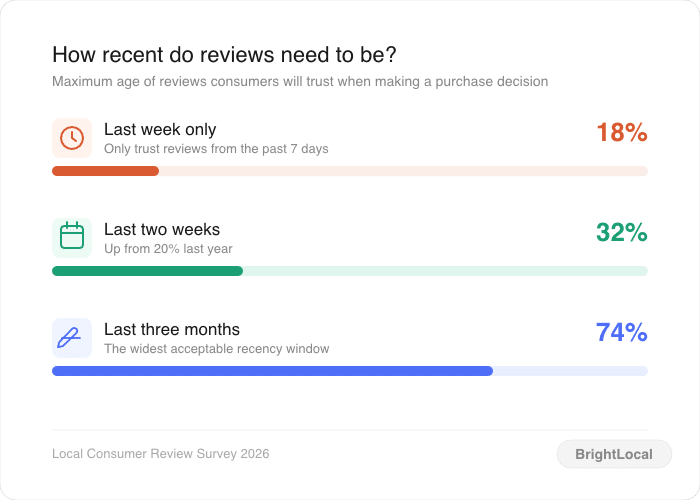
What this means for you: Stale reviews don’t just lose their persuasive power, but they actively work against you by signaling that your business may no longer be active or delivering the same results.
- Stat #13: 75% of consumers are concerned about encountering fake reviews when shopping online. [Bazaarvoice, 2024]
What this means for you: Buyers are reading your reviews with a skeptical eye, so one review that feels planted or generic can cast doubt on every other review on your page.
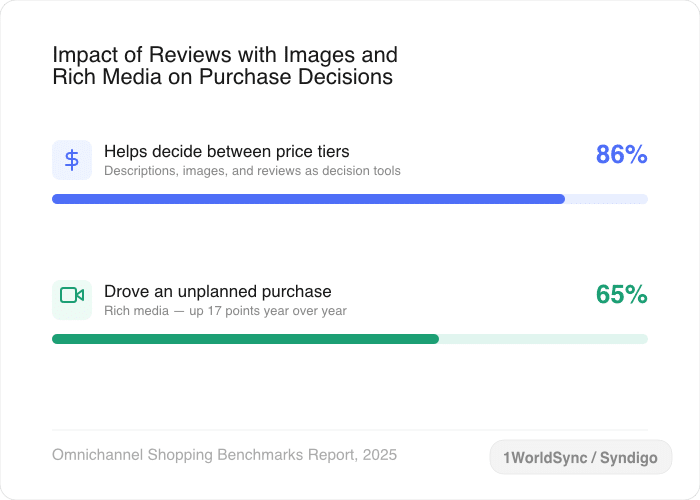
- Stat #14: 67% of consumers say ratings and reviews combined with customer photos and videos have persuaded them to buy a product. [1WorldSync, 2024]
What this means for you: Visual proof and verified-buyer badges aren’t extras, they’re the specific signals buyers look for when deciding whether a review is worth trusting at all.
- Stat #15: Consumers’ purchase intention rises by 8% when negative reviews are shown before positive ones. [Zhuang et al., 2025]
What this means for you: A negative review that received a calm, professional response can actually increase buyer confidence, because buyers want to see accountability more than they want to see perfection.
The pattern across all of these is the same: real, recent, responded-to reviews build more trust than a handful of polished five-stars. The good news is, keeping your reviews fresh doesn’t have to be a manual process.
The Real Cost of Having No Reviews (Or Ignoring Them)
Reviews aren’t just a nice-to-have. Missing them, or letting them go stale, hits your revenue in ways that are measurable and surprisingly direct.
- Stat #16: A 1-star increase on Yelp correlates with a 5-9% increase in revenue. [Harvard Business School / Michael Luca, 2016]
- Stat #17: 94% of consumers say a negative review has convinced them to avoid a business entirely. [ReviewTrackers, 2022]
- Stat #18: Reviews account for 20% of local pack ranking signals, up from 16% in 2023. [BrightLocal / Whitespark Local Search Ranking Factors, 2025]
Think about what those three numbers add up to. A thin review profile doesn’t just hurt your credibility.
It quietly hands customers to competitors, shrinks your local search visibility, and puts a measurable cap on your revenue potential.
If you’ve ever wondered why a competitor with a worse product outranks you on Google Maps, this is probably part of the answer.
Conversion Rate Statistics
Here’s where reviews stop being a “nice to have” and start being a revenue lever.
Traffic that doesn’t convert is just noise. Reviews placed in the right spot on the right page change that faster than almost any other single fix. These stats connect directly to dollar outcomes.
- Stat #19: Displaying product reviews on your site can increase conversion rates by 10–30%. [Yotpo, 2024]
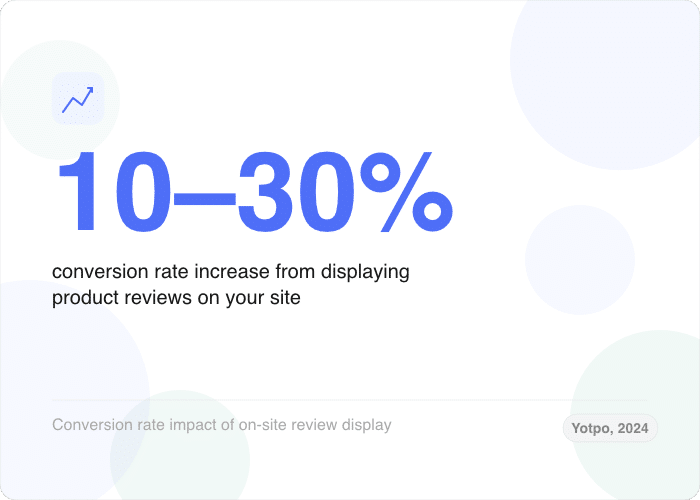
Yotpo’s research measured actual conversion data across e-commerce brands displaying reviews versus those without.
That 10–30% lift appears specifically on product pages where buyers are actively deciding to purchase. It’s not a passive benefit from having a reviews tab somewhere on your site.
- Stat #20: The conversion lift from reviews grows with volume. Shoppers exposed to just one review convert 76.7% more than those exposed to none, and those exposed to 5,000+ reviews convert at nearly 3x the rate. [PowerReviews, 2021]
This means your first 50 reviews are your most valuable. Getting to that first threshold quickly has a direct, measurable impact on sales.
- Stat #21: Shoppers who interact with ratings and reviews see a 108.6% lift in conversion compared to those who don’t. [PowerReviews, 2023]
This means buyers who stop and actually read your reviews are already primed to buy. The goal isn’t just having reviews. It’s placing them where buyers naturally pause and engage.
Pro Tip: A tool like Reviews Feed Pro lets you pull live Google and Yelp reviews onto any page, including your homepage, your pricing page, and your product pages, so buyers see social proof exactly where they’re deciding.
- Stat #22: 19% of shoppers abandon their cart because they don’t trust the site with their card information. [Baymard Institute, 2024]
If nearly 1 in 5 buyers walks away over a trust concern, reviews near your checkout or product decision point address exactly what’s costing you those conversions.
- Stat #23: Engaging with UGC, including reviews, can boost revenue per visitor by 162% and increase average order value by around 13%. [Bazaarvoice Shopper Experience Index, 2022]
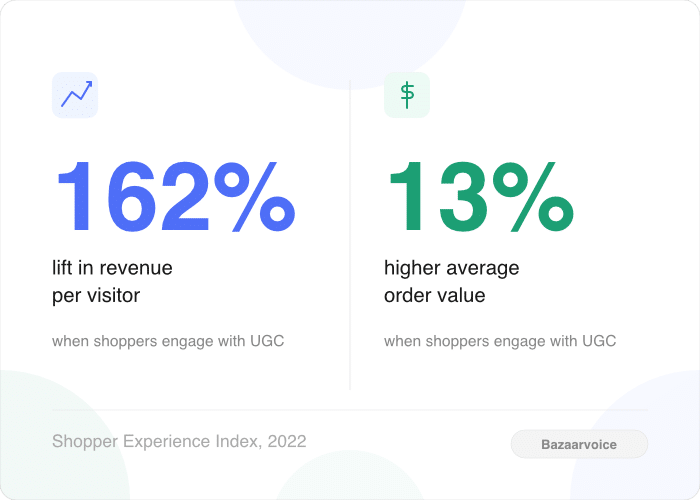
Social proof doesn’t just push buyers over the line. It shifts how much they’re willing to spend. A buyer who trusts your reviews is more likely to choose the higher-tier option and skip the comparison shopping entirely.
- Stat #24: Adding customer testimonials to a landing page has increased conversions by up to 34% in documented split tests. [VWO Case Studies]
This means social proof isn’t just a product page asset. Your paid ad destinations, email landing pages, and signup forms all benefit from well-placed reviews. Every channel you’re already running can capture this lift.
- Stat #25: Only 20% of consumers fully trust reviews on a brand’s own website. This makes third-party review platforms a critical complement to on-site social proof. [Trustpilot/Oberlo, 2022]
Third-party platforms like Google and Yelp are where people find you. But they are not where people buy from you.
The data shows that reviews need to be present at the exact moment the purchase decision is made, not sitting on another site that requires a separate search.
Pulling that third-party credibility onto your pages is how you get the trust signal and the conversion lift working together.
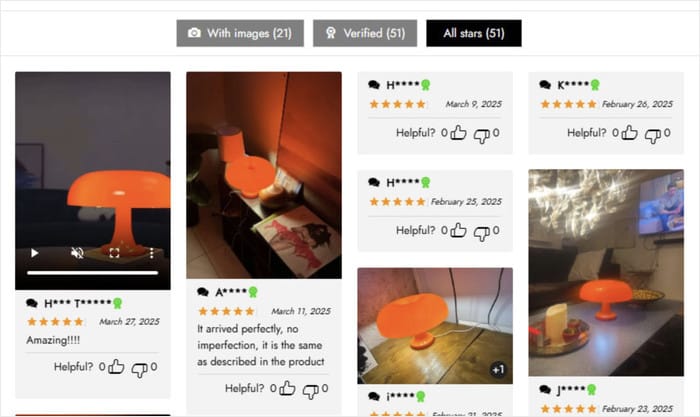
To start capturing this lift, check out this guide on adding social media review widgets to your website.
Platform-Specific Social Proof Statistics
Not all review platforms are created equal. Here’s how the major ones stack up.
Where your buyers go to check reviews depends on what they’re buying, how old they are, and what question they’re trying to answer. Different platforms attract different buyers at different stages of their decision. Here’s what the data shows for the five platforms that drive the most purchase activity.
Google Reviews:
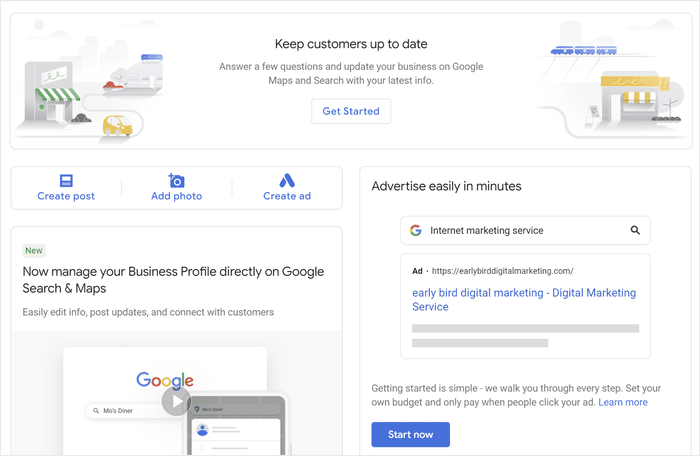
- Stat #26: 87% of consumers used Google to evaluate a local business in 2023. [BrightLocal, 2023]
Google is the default starting point for most buyers, across nearly every business type and purchase category.
When a buyer types your business name into search, your star rating appears before they ever reach your website. Your Google reviews are doing sales work around the clock, whether you’re paying attention or not.
Yelp:
- Stat #27: Yelp attracts over 75 million monthly visitors in the US, and 4 out of 5 Yelp users are ready to buy when they visit the platform. [Yelp/Comscore, 2025]
Yelp performs strongest in food, hospitality, and home services. Buyers on Yelp are typically further along in their decision than general search visitors.
They’ve already decided they want the service. They’re comparing businesses to see who delivers it best.
TripAdvisor:
- Stat #28: 96% of TripAdvisor users say reviews influence which hotels, restaurants, and attractions they book. [TripAdvisor/Ipsos MORI, 2019]
In travel and hospitality, TripAdvisor functions less like a review site and more like a required checkpoint before booking.
A business with strong TripAdvisor reviews captures travelers at the exact moment they’re comparing options and ready to commit. A business without them simply gets skipped.
Facebook Recommendations:
- Stat #29: 48% of consumers used Facebook to evaluate local businesses in 2023. [BrightLocal, 2023]
Facebook performs best with buyers aged 35 and above. Older consumers use it to check the Recommendations tab, ask friends directly, or scan what people in their network have said about a business.
For businesses that serve that demographic, Facebook reviews carry real weight in the final decision.
Trustpilot and G2 (B2B and SaaS):
- Stat #30: Software review sites rank as the second most trusted source at the final purchase decision stage for B2B buyers in North America. [G2 Buyer Behavior Report, 2025]
In software and B2B categories, review platforms function as procurement checkpoints. Buyers in these categories are often justifying a purchase to a team or manager, not just deciding for themselves.
A strong presence on G2 or Trustpilot makes it easier to get approval from a manager or team.
Which platform your buyer reaches for first depends on their age:
- Stat #31: Only 49% of Gen Z consumers default to Google for local search, compared to 66% of Boomers, with 1 in 4 Gen Z consumers turning to social media instead. [BrightLocal Consumer Search Behavior Report, 2025]
A strategy built entirely around one platform leaves a portion of your buyers underserved. Optimizing only for Google is a reasonable priority, but it won’t reach every segment of your audience with equal force.
What this means for your website: the platform question matters less than whether those reviews show up where your buyers are actually deciding.
A buyer who finds you on Google still needs to feel confident once they land on your site.
Reviews embedded on your homepage, product pages, or pricing page close that gap at exactly the right moment, pulling in credibility from whichever platform your buyers trust most.
Don’t worry, you don’t have to pick one platform and commit. A feed that pulls from multiple sources gives you the widest coverage with no extra effort.
Social Media as Social Proof Statistics
Reviews on Google and Yelp do a lot of heavy lifting, but they’re not the whole picture.
The way people discover and validate businesses has expanded across social platforms, and the data shows a clear pattern: real people, real voices, and real experiences outperform polished brand content every time.
These final four stats close out the 35-stat count, and they point to a shift that every business owner should understand before deciding where to invest their trust-building efforts.
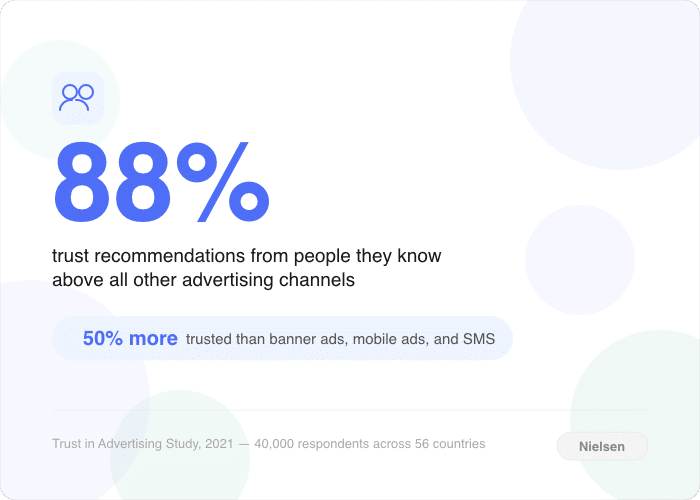
- Stat #32: 88% of consumers trust recommendations from people they know above all other forms of advertising. [Nielsen Global Trust in Advertising, 2021]
When a real customer says your product changed their morning routine, that one sentence does more work than a professionally designed ad.
Your buyers know the difference between a brand talking about itself and a person with no stake in the outcome sharing what they actually experienced.
- Stat #33: 66% of consumers say they’d be more likely to purchase after watching a testimonial video showing how a business helped someone like them. [Wyzowl, 2025]
A buyer watching a real customer explain exactly why they chose you is seeing themselves in that story. Video removes the distance that written reviews leave.
When a viewer recognizes their own problem in someone else’s experience, the decision to buy becomes much easier to make.
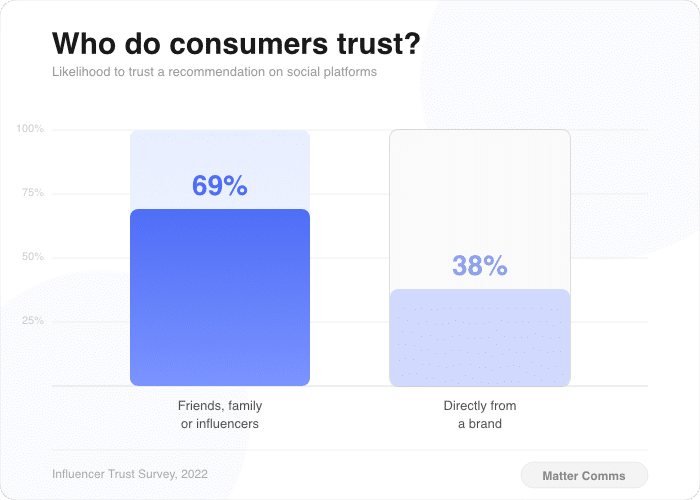
- Stat #34: 69% of consumers trust a recommendation from a friend, family member, or relatable influencer, compared to just 38% who trust the same information coming directly from a brand. [Matter Communications, 2023]
A recommendation from someone who shares your buyer’s situation, budget, and concerns carries more weight than a sponsored post from a celebrity with a discount code.
Your customers are your most persuasive sales team, and most businesses aren’t using them.
- Stat #35: 76% of consumers say social media content has influenced a purchase in the past six months, rising to 90% among Gen Z. [Sprout Social, 2025]
When buyers scroll past your posts and see other customers tagging you, sharing results, or asking questions and getting answers, that activity is evidence your business is real, responsive, and trusted by people like them.
The pattern here is the same across every channel: real people saying real things outperform polished marketing every time.
Finally, the question is whether you’re making it easy for buyers to find those real voices on your site.
What These Stats Mean for Your Website
Across dozens of studies and hundreds of thousands of data points, the pattern is consistent: reviews are the single most trusted input in a buying decision.
But the issue is showcasing the reviews to your potential customers when they’re about to make a purchase.
Screenshots go stale within weeks. Manually copy-pasted testimonials don’t scale, and savvy buyers know cherry-picked quotes when they see them.
Each of those problems erodes the trust you’re trying to build. A live, synced review feed solves all three since it’s always current, shows the full picture, runs automatically.

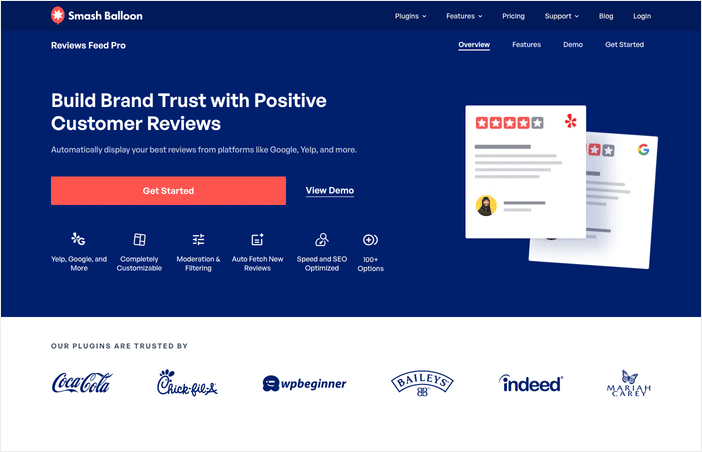
This is exactly what Reviews Feed Pro is built to do. It connects your website to the biggest review sites in the world: Google, Facebook, Yelp, WordPress.org, TripAdvisor, Trustpilot, and WooCommerce.
After that, you can create review feeds that automatically fetch customer reviews directly to any page on your site.
You set it up once, and your social proof stays fresh without any manual work.
What You Get Out of the Box
- New reviews from your connected platforms appear automatically, so your social proof is always fresh.
- Choose from list, carousel, or masonry layouts and customize colors, spacing, fonts, and more with an intuitive visual editor.
- Want to filter out reviews below a certain star rating? Feature a specific glowing testimonial prominently? The visual moderation system gives you full control.
- Review data is cached, and images are resized automatically, so your page load times stay fast even with a full review feed embedded.
- For extra social proof, you can showcase high-quality reviews as popups on your website with full control over where and when they appear.

Why This Matters More Than Another Design Tweak
Most conversion rate optimization advice focuses on button colors, headlines, and page layout.
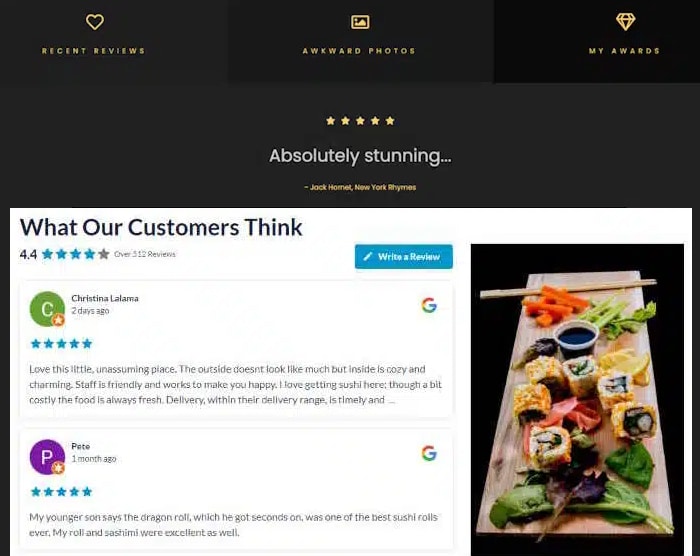
Reviews Feed Pro addresses something more fundamental: the trust gap between a visitor landing on your site and that visitor becoming a customer.
The stats from this post make that gap measurable: 34% lift from testimonials on a landing page and 108.6% conversion boost when shoppers interact with ratings.
Those numbers don’t come from having reviews somewhere on the internet. They come from reviews being visible when the decision is being made.
Get Reviews Feed Pro and add social proof to your website with ease.
For a demonstration, check out our step-by-step guide on adding Google reviews to your website using Reviews Feed Pro.
Start Displaying Reviews on Your Website Today
Now you know that 98% of your potential customers are reading reviews before they decide. But the question is whether those reviews are showing up where the decision actually happens.
You don’t need to overhaul anything or hire a developer. Reviews Feed Pro connects to your existing review platforms and puts a live, automatically updating feed on any page in minutes.
With this all-in-one review aggregator, you can have social proof from the biggest review sites and your own WooCommerce store in a single place ready to boost conversions.
Grab a copy of Reviews Feed Pro and start turning reviews into revenue.
More Online Marketing Guides and Tutorials
- How to Use YouTube for Your Business (Complete Guide)
- Is Marketing on TikTok Worth It for Small Businesses
- How to Use Google Reviews to Get More Customers
- Google Reviews vs Trustpilot: Which Is Better for Your Business?